Domanda del libro di testo
Write a short essay that discusses the difference between the more traditional Mendelian and neo-Mendelian modes of inheritance (qualitative inheritance) and quantitative inheritance.
448
views

 Klug 12th EditionCh. 25 - Quantitative Genetics and Multifactorial TraitsProblema 1e
 Guida verificata passo dopo passo
 03:59
03:59
 09:28
09:28 07:55
07:55Write a short essay that discusses the difference between the more traditional Mendelian and neo-Mendelian modes of inheritance (qualitative inheritance) and quantitative inheritance.
How can we ascertain the number of polygenes involved in the inheritance of a quantitative trait?
Define the following:
(a) Polygenic
(b) Additive alleles
(c) Correlation
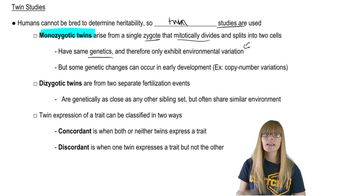
(d) Monozygotic and dizygotic twins
(e) Heritability
(f) QTL
(g) Continuous variation
What findings led geneticists to postulate the multiple-factor hypothesis that invoked the idea of additive alleles to explain inheritance patterns?
How do we assess environmental factors to determine if they impact the phenotype of a quantitatively inherited trait?
A dark-red strain and a white strain of wheat are crossed and produce an intermediate, medium-red F₁. When the F₁ plants are interbred, an F₂ generation is produced in a ratio of 1 dark-red: 4 medium-dark-red: 6 medium-red: 4 light-red: 1 white. Further crosses reveal that the dark-red and white F₂ plants are true breeding
Based on the ratios in the F₂ population, how many genes are involved in the production of color?