Ch. 3 - Mendelian Genetics
Klug - Concepts of Genetics 12th Edition
Klug12th EditionConcepts of GeneticsISBN: 9780135564776Non è quello che usi tu?Cambia libro di testo
Capitolo 3, Problema 30a

Albinism, caused by a mutational disruption in melanin (skin pigment) production, has been observed in many species, including humans. In 1991, and again recently in 2017, the only documented observations of an albino humpback whale (named 'Migaloo') were observed near New South Wales. Recently, Polanowski and coworkers (Polanowski, A., S. Robinson-Laverick, and D. Paton. (2012). Journal of Heredity 103:130–133) studied the genetics of humpback whales from the east coast of Australia, including Migaloo. Assuming that Migaloo's albinism is caused by a rare recessive gene, what would be the likelihood of the establishment of a natural robust subpopulation of albino white humpback whales in this population?

Guida verificata passo dopo passo
1
Understand the genetic basis of albinism: Albinism is caused by a recessive allele. For an individual to express albinism, they must inherit two copies of the recessive allele (homozygous recessive, denoted as 'aa'). If an individual has one dominant allele and one recessive allele (heterozygous, 'Aa'), they will not express albinism but can pass the recessive allele to their offspring.
Determine the initial frequency of the recessive allele in the population: Since albinism is rare, the frequency of the recessive allele (denoted as 'q') is likely very low. The frequency of the dominant allele (denoted as 'p') can be calculated using the Hardy-Weinberg equation: \( p + q = 1 \).
Use the Hardy-Weinberg principle to estimate the proportion of albino individuals: The proportion of individuals in the population who are homozygous recessive (\( aa \)) and express albinism can be calculated as \( q^2 \), where \( q \) is the frequency of the recessive allele.
Assess the likelihood of a robust subpopulation: For a robust subpopulation of albino whales to establish, there must be a sufficient number of individuals carrying the recessive allele (both homozygous recessive and heterozygous carriers) and a mechanism for these individuals to preferentially mate with each other. This is unlikely in a natural population unless there is strong selection pressure or non-random mating favoring albino individuals.
Consider additional factors: Other factors, such as genetic drift, population size, and migration, could influence the frequency of the recessive allele over time. In small populations, genetic drift could lead to the loss of the recessive allele, while in larger populations, the allele frequency is more stable but still unlikely to increase significantly without selective pressures.

Risposta video verificata per un problema simile:

Questa soluzione video è stata consigliata dai nostri tutor come utile per risolvere questo problema.
Durata del video:
1m

Concetti chiave

Ecco i concetti essenziali che devi comprendere per rispondere correttamente alla domanda.

Recessive Genes

Recessive genes are alleles that do not manifest their traits in the presence of a dominant allele. For an individual to express a recessive trait, such as albinism, they must inherit two copies of the recessive allele, one from each parent. This concept is crucial for understanding the inheritance patterns of traits and predicting the likelihood of their occurrence in a population.
Video consigliato:

Population Genetics

Population genetics is the study of genetic variation within populations and how these variations change over time due to factors like natural selection, genetic drift, and gene flow. It provides the framework for understanding how traits, such as albinism, can spread or diminish in a population, influencing the potential for establishing a subpopulation of albino individuals.
Video consigliato:
Percorso guidato
03:45
Descriptive Genetics

Hardy-Weinberg Equilibrium

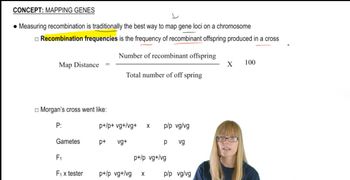
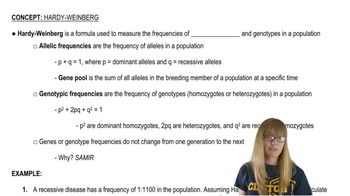
The Hardy-Weinberg equilibrium is a principle that describes the genetic variation in a population that is not evolving. It provides a baseline to predict allele frequencies and genotype distributions under ideal conditions. Understanding this concept helps assess whether the conditions for establishing a robust subpopulation of albino humpback whales are met, considering factors like mutation rates and selection pressures.
Video consigliato:
Pratica correlata
Domanda del libro di testo

To assess Mendel's law of segregation using tomatoes, a true-breeding tall variety (SS) is crossed with a true-breeding short variety (ss). The heterozygous F₁ tall plants (Ss) were crossed to produce two sets of F₂ data, as follows.

From the above analysis, what can you conclude about the importance of generating large datasets in experimental conditions?

483
views
Domanda del libro di testo

Albinism, caused by a mutational disruption in melanin (skin pigment) production, has been observed in many species, including humans. In 1991, and again recently in 2017, the only documented observations of an albino humpback whale (named 'Migaloo') were observed near New South Wales. Recently, Polanowski and coworkers (Polanowski, A., S. Robinson-Laverick, and D. Paton. (2012). Journal of Heredity 103:130–133) studied the genetics of humpback whales from the east coast of Australia, including Migaloo. What data would be helpful in determining the answer to part (a)?

450
views
Domanda del libro di testo

Albinism, caused by a mutational disruption in melanin (skin pigment) production, has been observed in many species, including humans. In 1991, and again recently in 2017, the only documented observations of an albino humpback whale (named 'Migaloo') were observed near New South Wales. Recently, Polanowski and coworkers (Polanowski, A., S. Robinson-Laverick, and D. Paton. (2012). Journal of Heredity 103:130–133) studied the genetics of humpback whales from the east coast of Australia, including Migaloo. Assuming that Migaloo's albinism is caused by a rare dominant gene, what would be the likelihood of the establishment of a natural robust subpopulation of albino white humpback whales in this population?

602
views
Domanda del libro di testo

Albinism, caused by a mutational disruption in melanin (skin pigment) production, has been observed in many species, including humans. In 1991, and again recently in 2017, the only documented observations of an albino humpback whale (named 'Migaloo') were observed near New South Wales. Recently, Polanowski and coworkers (Polanowski, A., S. Robinson-Laverick, and D. Paton. (2012). Journal of Heredity 103:130–133) studied the genetics of humpback whales from the east coast of Australia, including Migaloo. Do you think that Migaloo's albinism is more likely caused by a dominant or recessive mutation? Explain your reasoning.

613
views