Ch. 3 - Mendelian Genetics
Klug - Concepts of Genetics 12th Edition
Klug12th EditionConcepts of GeneticsISBN: 9780135564776Non è quello che usi tu?Cambia libro di testo
Capitolo 3, Problema 11

What is the basis for homology among chromosomes?

Guida verificata passo dopo passo
1
Homology among chromosomes is based on the similarity in their DNA sequences, which indicates a shared evolutionary origin.
Homologous chromosomes are pairs of chromosomes (one from each parent) that have the same genes at the same loci, but they may have different alleles for those genes.
The structural basis for homology includes similar length, centromere position, and banding patterns when stained during karyotyping.
During meiosis, homologous chromosomes pair up in a process called synapsis, facilitated by the synaptonemal complex, which ensures proper alignment and recombination.
Homology is critical for genetic recombination (crossing over) during meiosis, which increases genetic diversity by exchanging genetic material between homologous chromosomes.

Risposta video verificata per un problema simile:

Questa soluzione video è stata consigliata dai nostri tutor come utile per risolvere questo problema.
Durata del video:
1m

Concetti chiave

Ecco i concetti essenziali che devi comprendere per rispondere correttamente alla domanda.

Chromosomal Homology

Chromosomal homology refers to the similarity between chromosomes that arise from shared ancestry. Homologous chromosomes have the same genes at the same loci, but may carry different alleles. This concept is crucial for understanding genetic variation and inheritance patterns, as homologous chromosomes pair during meiosis, facilitating genetic recombination.
Video consigliato:
Percorso guidato
07:10
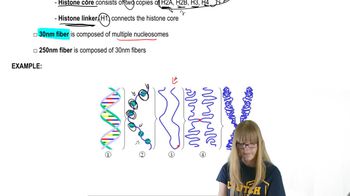
Chromosome Structure

Gene Structure and Function

Genes are segments of DNA that encode for proteins and determine traits. Understanding gene structure, including exons and introns, is essential for grasping how homologous chromosomes can carry variations of the same gene. This knowledge helps explain how genetic diversity arises through mutations and recombination during sexual reproduction.
Video consigliato:
Percorso guidato
08:26
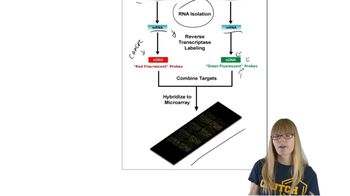
Functional Genomics

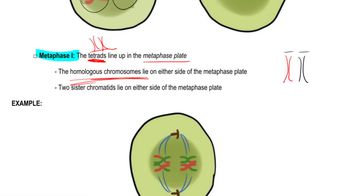
Meiosis and Genetic Recombination

Meiosis is the process of cell division that produces gametes with half the number of chromosomes. During meiosis, homologous chromosomes undergo recombination, where segments of DNA are exchanged, leading to genetic diversity. This process is fundamental to understanding how homologous chromosomes contribute to variation in offspring and the evolutionary significance of genetic diversity.
Video consigliato:
Pratica correlata
Domanda del libro di testo

In Drosophila, gray body color is dominant to ebony body color, while long wings are dominant to vestigial wings. Assuming that the P₁ individuals are homozygous, work the following crosses through the F₂ generation, and determine the genotypic and phenotypic ratios for each generation.

gray, vestigial x ebony, long

424
views
Domanda del libro di testo

In Drosophila, gray body color is dominant to ebony body color, while long wings are dominant to vestigial wings. Assuming that the P₁ individuals are homozygous, work the following crosses through the F₂ generation, and determine the genotypic and phenotypic ratios for each generation.

gray, long x ebony, vestigial

1563
views
Domanda del libro di testo

In Drosophila, gray body color is dominant to ebony body color, while long wings are dominant to vestigial wings. Assuming that the P₁ individuals are homozygous, work the following crosses through the F₂ generation, and determine the genotypic and phenotypic ratios for each generation.

gray, long x gray, vestigial.

462
views
Domanda del libro di testo

In a cross between a black and a white guinea pig, all members of the F₁ generation are black. The F₂ generation is made up of approximately 3/4 black and 1/4 white guinea pigs. What will the offspring be like if two F₂ white guinea pigs are mated?

708
views
Domanda del libro di testo

In a cross between a black and a white guinea pig, all members of the F₁ generation are black. The F₂ generation is made up of approximately 3/4 black and 1/4 white guinea pigs. Two different matings were made between black members of the F₂ generation, with the following results. Diagram each of the crosses.

Cross Offspring

Cross 1 All black

Cross 2 3/4 black, 1/4 white

818
views
Domanda del libro di testo

In a cross between a black and a white guinea pig, all members of the F₁ generation are black. The F₂ generation is made up of approximately 3/4 black and 1/4 white guinea pigs. Diagram this cross, showing the genotypes and phenotypes.

2973
views