Ch. 3 - Mendelian Genetics
Klug - Concepts of Genetics 12th Edition
Klug12th EditionConcepts of GeneticsISBN: 9780135564776Non è quello che usi tu?Cambia libro di testo
Capitolo 3, Problema 4

Which of Mendel's postulates are illustrated by the pedigree that you constructed in Problem 3? List and define these postulates.

Guida verificata passo dopo passo
1
Recall Mendel's three main postulates: the Law of Segregation, the Law of Independent Assortment, and the Law of Dominance.
Examine the pedigree you constructed in Problem 3 to identify patterns of inheritance, such as whether traits appear in every generation or skip generations, and whether traits are inherited independently or together.
Determine if the Law of Segregation is illustrated by observing that each individual inherits one allele from each parent, which explains how traits can reappear after skipping a generation.
Check if the Law of Independent Assortment is demonstrated by seeing if different traits are inherited independently of each other, which would be evident if the pedigree shows no consistent linkage between traits.
Identify if the Law of Dominance applies by noting whether one trait consistently masks the presence of another in heterozygous individuals, as shown by dominant and recessive phenotypes in the pedigree.

Risposta video verificata per un problema simile:

Questa soluzione video è stata consigliata dai nostri tutor come utile per risolvere questo problema.
Durata del video:
3m

Concetti chiave

Ecco i concetti essenziali che devi comprendere per rispondere correttamente alla domanda.

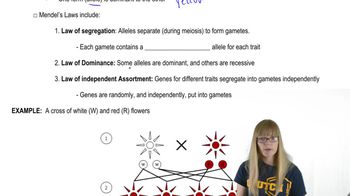
Mendel's Law of Segregation

This postulate states that each individual has two alleles for each gene, which segregate during gamete formation so that each gamete carries only one allele. It explains how traits are inherited as discrete units and is fundamental to understanding inheritance patterns shown in pedigrees.
Video consigliato:

Mendel's Law of Independent Assortment

This law states that alleles of different genes assort independently of one another during gamete formation. It accounts for the genetic variation seen in offspring and helps interpret how multiple traits may be inherited separately in a pedigree.
Video consigliato:

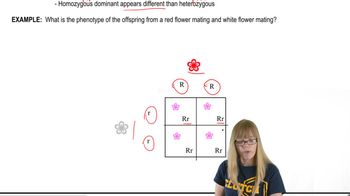
Mendel's Concept of Dominance

Mendel proposed that some alleles are dominant and mask the expression of recessive alleles in heterozygotes. This concept is crucial for understanding how traits appear in pedigrees, especially when dominant and recessive phenotypes are tracked across generations.
Video consigliato:
Percorso guidato
04:37
Variations on Dominance
Pratica correlata
Domanda del libro di testo

Albinism in humans is inherited as a simple recessive trait. For the following families, determine the genotypes of the parents and offspring. (When two alternative genotypes are possible, list both.)

A normal male and an albino female have six children, three normal and three albino.

1293
views
Domanda del libro di testo

Mendel crossed peas having round seeds and yellow cotyledons (seed leaves) with peas having wrinkled seeds and green cotyledons. All the F₁ plants had round seeds with yellow cotyledons. Diagram this cross through the F₂ generation, using both the Punnett square and forked-line, or branch diagram, methods.

870
views
Domanda del libro di testo

What advantages were provided by Mendel's choice of the garden pea in his experiments?

779
views
Domanda del libro di testo

Discuss how Mendel's monohybrid results served as the basis for all but one of his postulates. Which postulate was not based on these results? Why?

575
views
1
rank
Domanda del libro di testo

Albinism in humans is inherited as a simple recessive trait. For the following families, determine the genotypes of the parents and offspring. (When two alternative genotypes are possible, list both.)

A normal male and an albino female have six children, all normal.

1277
views
Domanda del libro di testo

Albinism in humans is inherited as a simple recessive trait. For the following families, determine the genotypes of the parents and offspring. (When two alternative genotypes are possible, list both.)

Construct a pedigree of the families in (b) and (c). Assume that one of the normal children in (b) and one of the albino children in (c) become the parents of eight children. Add these children to the pedigree, predicting their phenotypes (normal or albino).

1204
views