Ch. 4 - Extensions of Mendelian Genetics
Klug - Concepts of Genetics 12th Edition
Klug12th EditionConcepts of GeneticsISBN: 9780135564776Non è quello che usi tu?Cambia libro di testo
Capitolo 4, Problema 1b

In the discussion, we focused on extensions and modifications of Mendelian principles and ratios. In the process, we encountered many opportunities to consider how this information was acquired. On the basis of these discussions, what answers would you propose to the following fundamental questions?
How did geneticists determine that inheritance of some phenotypic characteristics involves the interactions of two or more gene pairs? How were they able to determine how many gene pairs were involved?

Guida verificata passo dopo passo
1
Start by understanding that classical Mendelian genetics initially focused on traits controlled by a single gene pair, which showed clear dominant and recessive patterns. However, some traits did not follow these simple ratios, suggesting more complex inheritance.
Geneticists observed deviations from Mendelian ratios (such as 9:3:3:1 in dihybrid crosses) in offspring phenotypes, indicating that multiple gene pairs might interact to produce a trait. They used controlled breeding experiments to track these patterns across generations.
To determine the number of gene pairs involved, geneticists performed dihybrid and multihybrid crosses, analyzing the phenotypic ratios of offspring. By comparing observed ratios to expected Mendelian ratios, they inferred the minimum number of gene pairs influencing the trait.
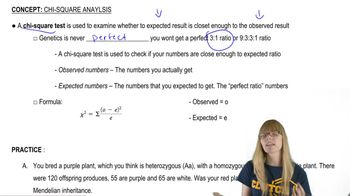
They also used statistical methods, such as the chi-square test, to assess how well the observed data fit expected ratios for different numbers of gene pairs, helping to confirm the involvement of multiple genes.
Finally, geneticists employed techniques like test crosses and pedigree analysis to further dissect gene interactions, including epistasis and polygenic inheritance, which clarified how multiple gene pairs contribute to phenotypic characteristics.

Risposta video verificata per un problema simile:

Questa soluzione video è stata consigliata dai nostri tutor come utile per risolvere questo problema.
Durata del video:
2m

Concetti chiave

Ecco i concetti essenziali che devi comprendere per rispondere correttamente alla domanda.

Extensions of Mendelian Inheritance

Mendelian inheritance describes traits controlled by single gene pairs with clear dominant and recessive alleles. Extensions include interactions like epistasis, incomplete dominance, and polygenic inheritance, where multiple gene pairs influence a phenotype, leading to modified phenotypic ratios beyond classic Mendelian patterns.
Video consigliato:
Percorso guidato
05:13
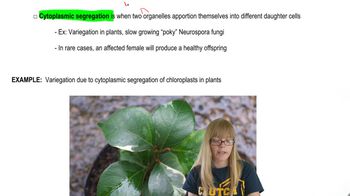
Organelle Inheritance

Genetic Analysis through Phenotypic Ratios

Geneticists use observed phenotypic ratios from controlled crosses to infer gene interactions. Deviations from expected Mendelian ratios suggest multiple gene pairs or gene interactions, allowing researchers to hypothesize the number and nature of genes involved in trait inheritance.
Video consigliato:
Percorso guidato
02:48
Chi Square Analysis

Complementation and Test Crosses

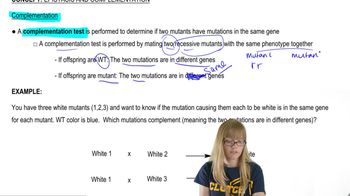
Complementation tests and test crosses help determine if different mutations affect the same gene or different genes. By analyzing offspring phenotypes from these crosses, geneticists can identify the number of gene pairs involved and how they interact to produce a phenotype.
Video consigliato:
Percorso guidato
05:05
Complementation