Ch. 4 - Extensions of Mendelian Genetics
Klug - Concepts of Genetics 12th Edition
Klug12th EditionConcepts of GeneticsISBN: 9780135564776Non è quello che usi tu?Cambia libro di testo
Capitolo 4, Problema 19a

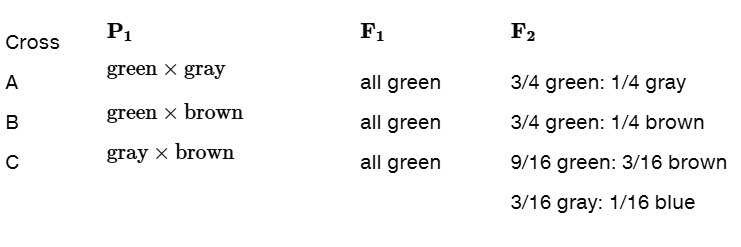
In a species of the cat family, eye color can be gray, blue, green, or brown, and each trait is true breeding. In separate crosses involving homozygous parents, the following data were obtained:

How many genes are involved? Define gene symbols and indicate which genotypes yield each phenotype.

Guida verificata passo dopo passo
1
Step 1: Analyze the phenotypic ratios in the F2 generation for each cross to determine the number of genes involved. For Cross A and Cross B, the 3:1 ratio suggests a single gene with green being dominant over gray and brown, respectively. For Cross C, the 9:3:3:1 ratio indicates the involvement of two genes with independent assortment.
Step 2: Assign gene symbols to represent the traits. For example, let 'G' represent the gene for green color (dominant) and 'g' for gray (recessive). Introduce a second gene, 'B', for brown color (dominant) and 'b' for blue (recessive).
Step 3: Define the genotypes for each phenotype based on the data. For green eyes, the genotype could be 'G_' (where '_' can be either 'G' or 'g'). For gray eyes, the genotype is 'gg'. For brown eyes, the genotype is 'G_bb'. For blue eyes, the genotype is 'ggbb'.
Step 4: Explain the F1 generation results. In Cross A and Cross B, the F1 generation is all green because green is dominant over both gray and brown. In Cross C, the F1 generation is all green because the dominant alleles 'G' and 'B' mask the recessive alleles.
Step 5: Use the F2 generation ratios to confirm the genetic model. For Cross A and Cross B, the 3:1 ratio confirms a single gene with dominance. For Cross C, the 9:3:3:1 ratio confirms two genes with independent assortment, where the phenotypes are determined by combinations of the alleles for both genes.

Risposta video verificata per un problema simile:

Questa soluzione video è stata consigliata dai nostri tutor come utile per risolvere questo problema.
Durata del video:
1m

Concetti chiave

Ecco i concetti essenziali che devi comprendere per rispondere correttamente alla domanda.

Mendelian Genetics

Mendelian genetics is the study of how traits are inherited through generations based on the principles established by Gregor Mendel. It includes concepts such as dominant and recessive alleles, homozygous and heterozygous genotypes, and the segregation and independent assortment of genes. Understanding these principles is crucial for analyzing inheritance patterns, such as those seen in the eye color crosses provided.
Video consigliato:
Percorso guidato
03:45
Descriptive Genetics

Gene Interaction

Gene interaction refers to the way different genes influence the expression of traits, which can lead to complex inheritance patterns. In the context of the question, multiple genes may be involved in determining eye color, with some genes potentially exhibiting epistasis or additive effects. Recognizing how these interactions affect phenotypic ratios in offspring is essential for interpreting the data from the crosses.
Video consigliato:
Percorso guidato
07:56
Interacting Genes Overview

Phenotypic Ratios

Phenotypic ratios are the relative frequencies of different phenotypes in the offspring resulting from genetic crosses. These ratios can provide insights into the underlying genotypes and the number of genes involved. In the given data, analyzing the ratios from the F₂ generations helps determine the genetic basis of the observed traits, allowing for the identification of gene symbols and the genotypes that correspond to each phenotype.
Video consigliato:
Percorso guidato
10:48
Mutations and Phenotypes
Pratica correlata
Domanda del libro di testo

In a plant, a tall variety was crossed with a dwarf variety. All F₁ plants were tall. When F₁xF₁ plants were interbred, 9/16 of the F₂ were tall and 7/16 were dwarf. What proportion of the F₂ plants will be true breeding if self-fertilized? List these genotypes.

523
views
Domanda del libro di testo

Given the inheritance pattern of coat color in rats described in Problem 17, predict the genotype and phenotype of the parents who produced the following offspring: 27/64 gray:

16/64 albino: 9/64 yellow: 9/64 black: 3/64 cream

457
views
Domanda del libro di testo

Given the inheritance pattern of coat color in rats described in Problem 17, predict the genotype and phenotype of the parents who produced the following offspring:

3/8 black: 3/8 cream: 2/8 albino

462
views
Domanda del libro di testo

In a species of the cat family, eye color can be gray, blue, green, or brown, and each trait is true breeding. In separate crosses involving homozygous parents, the following data were obtained:

In a cross between a gray-eyed cat and one of unknown genotype and phenotype, the F₁ generation was not observed. However, the F₂ resulted in the same F₂ ratio as in cross C. Determine the genotypes and phenotypes of the unknown P₁ and F₁ cats.

583
views
Domanda del libro di testo

In a plant, a tall variety was crossed with a dwarf variety. All F₁ plants were tall. When F₁xF₁ plants were interbred, 9/16 of the F₂ were tall and 7/16 were dwarf. Explain the inheritance of height by indicating the number of gene pairs involved and by designating which genotypes yield tall and which yield dwarf. (Use dashes where appropriate.)

799
views
Domanda del libro di testo

Given the inheritance pattern of coat color in rats described in Problem 17, predict the genotype and phenotype of the parents who produced the following offspring:

3/8 black: 4/8 albino: 1/8 cream

487
views