

Ch. 6 - Genetic Analysis and Mapping in Bacteria and Bacteriophages
Klug - Concepts of Genetics 12th Edition
Klug12th EditionConcepts of GeneticsISBN: 9780135564776Non è quello che usi tu?Cambia libro di testo
Capitolo 6, Problema 28c

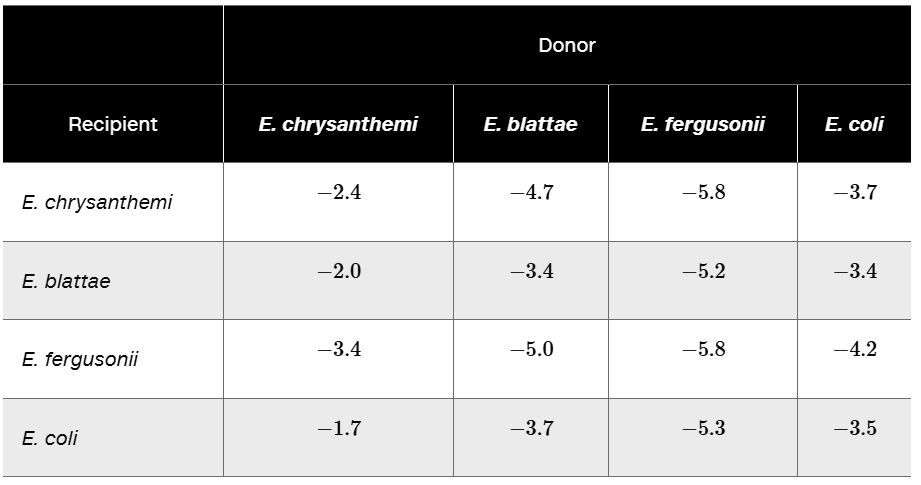
Bacterial conjugation, mediated mainly by conjugative plasmids such as F, represents a potential health threat through the sharing of genes for pathogenicity or antibiotic resistance. Given that more than 400 different species of bacteria coinhabit a healthy human gut and more than 200 coinhabit human skin, Francisco Dionisio [(2002) Genetics 162:1525 1532] investigated the ability of plasmids to undergo between-species conjugal transfer. The following data are presented for various species of the enterobacterial genus Escherichia. The data are presented as 'log base 10' values; for example, -2.0 would be equivalent to 10⁻² as a rate of transfer. Assume that all differences between values presented are statistically significant.
Table showing log base 10 rates of plasmid transfer between four Escherichia species as donors and recipients.
What is the significance of these findings in terms of human health?

Guida verificata passo dopo passo
1
Step 1: Understand the data presented in the table. The values are log base 10 rates of plasmid transfer between different Escherichia species, where a value like -2.0 corresponds to a transfer rate of 10⁻². Lower (more negative) values indicate lower transfer rates, and higher (less negative) values indicate higher transfer rates.
Step 2: Analyze the pattern of plasmid transfer rates between species. Notice which donor-recipient pairs have higher transfer rates (values closer to zero) and which have lower rates (more negative values). This will help identify how easily plasmids can move between different species.
Step 3: Consider the biological significance of plasmid transfer. Since plasmids often carry genes for antibiotic resistance or pathogenicity, higher rates of transfer between species suggest a greater potential for spreading these traits across bacterial populations in the human body.
Step 4: Relate the findings to human health. Given that many bacterial species coexist in the human gut and skin, the ability of plasmids to transfer between species means that antibiotic resistance or virulence factors can spread more widely, potentially complicating treatment of infections.
Step 5: Summarize the overall significance. The data indicate that conjugative plasmids can transfer between different Escherichia species at varying rates, highlighting the risk of horizontal gene transfer contributing to the spread of antibiotic resistance and pathogenic traits in human-associated bacterial communities.

Risposta video verificata per un problema simile:

Questa soluzione video è stata consigliata dai nostri tutor come utile per risolvere questo problema.
Durata del video:
2m

Concetti chiave

Ecco i concetti essenziali che devi comprendere per rispondere correttamente alla domanda.

Bacterial Conjugation and Plasmid Transfer

Bacterial conjugation is a process where genetic material, often plasmids, is transferred directly between bacteria through cell-to-cell contact. Conjugative plasmids like the F plasmid carry genes that can include antibiotic resistance or virulence factors, enabling rapid spread of these traits across bacterial populations.
Video consigliato:

Logarithmic Scale in Measuring Transfer Rates

The rates of plasmid transfer are expressed as log base 10 values, where a value of -2 means a transfer rate of 10⁻². This logarithmic scale allows comparison of very small transfer rates, highlighting significant differences in conjugation efficiency between species pairs.
Video consigliato:
Percorso guidato
11:06
Mathematical Measurements

Implications for Human Health and Microbiome

Since diverse bacterial species coexist in the human gut and skin, the ability of plasmids to transfer between species facilitates the spread of antibiotic resistance and pathogenic traits. This interspecies gene transfer poses a health risk by potentially creating multidrug-resistant or more virulent bacterial strains.
Video consigliato:
Percorso guidato
06:51
Human Genome Composition
Pratica correlata
Domanda del libro di testo

A study was conducted in an attempt to determine which functional regions of a particular conjugative transfer gene (tra1) are involved in the transfer of plasmid R27 in Salmonella enterica. The R27 plasmid is of significant clinical interest because it is capable of encoding multiple-antibiotic resistance to typhoid fever. To identify functional regions responsible for conjugal transfer, an analysis was conducted by Lawley et al. (2002). J. Bacteriol. 184:2173-2180 was conducted in which particular regions of the tra1 gene were mutated and tested for their impact on conjugation. Shown here is a map of the regions tested and believed to be involved in conjugative transfer of the plasmid. Similar coloring indicates related function. Numbers correspond to each functional region subjected to mutation analysis.

Accompanying the map is a table showing the effects of these mutations on R27 conjugation.


Effects of Mutations in Functional Regions of Transfer Region 1 (tra1) on R27 Conjugation

Which regions appear to have the most impact on conjugation? 

458
views
Domanda del libro di testo

Bacterial conjugation, mediated mainly by conjugative plasmids such as F, represents a potential health threat through the sharing of genes for pathogenicity or antibiotic resistance. Given that more than 400 different species of bacteria coinhabit a healthy human gut and more than 200 coinhabit human skin, Francisco Dionisio [(2002) Genetics 162:1525 1532] investigated the ability of plasmids to undergo between-species conjugal transfer. The following data are presented for various species of the enterobacterial genus Escherichia. The data are presented as 'log base 10' values; for example, -2.0 would be equivalent to 10⁻² as a rate of transfer. Assume that all differences between values presented are statistically significant.

In what species is within-species transfer most likely? In what species pair is between-species transfer most likely?

843
views
Domanda del libro di testo

A study was conducted in an attempt to determine which functional regions of a particular conjugative transfer gene (tra1) are involved in the transfer of plasmid R27 in Salmonella enterica. The R27 plasmid is of significant clinical interest because it is capable of encoding multiple-antibiotic resistance to typhoid fever. To identify functional regions responsible for conjugal transfer, an analysis was conducted by Lawley et al. (2002). J. Bacteriol. 184:2173-2180 was conducted in which particular regions of the tra1 gene were mutated and tested for their impact on conjugation. Shown here is a map of the regions tested and believed to be involved in conjugative transfer of the plasmid. Similar coloring indicates related function. Numbers correspond to each functional region subjected to mutation analysis.

Accompanying the map is a table showing the effects of these mutations on R27 conjugation.


Effects of Mutations in Functional Regions of Transfer Region 1 (tra1) on R27 Conjugation


Which regions appear to have a limited impact on conjugation?

528
views
Domanda del libro di testo

A study was conducted in an attempt to determine which functional regions of a particular conjugative transfer gene (tra1) are involved in the transfer of plasmid R27 in Salmonella enterica. The R27 plasmid is of significant clinical interest because it is capable of encoding multiple-antibiotic resistance to typhoid fever. To identify functional regions responsible for conjugal transfer, an analysis was conducted by Lawley et al. (2002). J. Bacteriol. 184:2173-2180 was conducted in which particular regions of the tra1 gene were mutated and tested for their impact on conjugation. Shown here is a map of the regions tested and believed to be involved in conjugative transfer of the plasmid. Similar coloring indicates related function. Numbers correspond to each functional region subjected to mutation analysis.

Accompanying the map is a table showing the effects of these mutations on R27 conjugation.

Effects of Mutations in Functional Regions of Transfer Region 1 (tra1) on R27 Conjugation


Given the data, do all functional regions appear to influence conjugative transfer?

576
views
Domanda del libro di testo

For the experiment in Problem 26, another gene, g, was studied. It demonstrated positive cotransformation when tested with gene f. Predict the results of testing gene g with genes a, b, c, d, and e.

650
views
Domanda del libro di testo

Bacterial conjugation, mediated mainly by conjugative plasmids such as F, represents a potential health threat through the sharing of genes for pathogenicity or antibiotic resistance. Given that more than 400 different species of bacteria coinhabit a healthy human gut and more than 200 coinhabit human skin, Francisco Dionisio [(2002) Genetics 162:1525 1532] investigated the ability of plasmids to undergo between-species conjugal transfer. The following data are presented for various species of the enterobacterial genus Escherichia. The data are presented as 'log base 10' values; for example, -2.0 would be equivalent to 10⁻² as a rate of transfer. Assume that all differences between values presented are statistically significant.

What general conclusion(s) can be drawn from these data?

867
views