Ch. 6 - Genetic Analysis and Mapping in Bacteria and Bacteriophages
Klug - Concepts of Genetics 12th Edition
Klug12th EditionConcepts of GeneticsISBN: 9780135564776Non è quello che usi tu?Cambia libro di testo
Capitolo 6, Problema 23

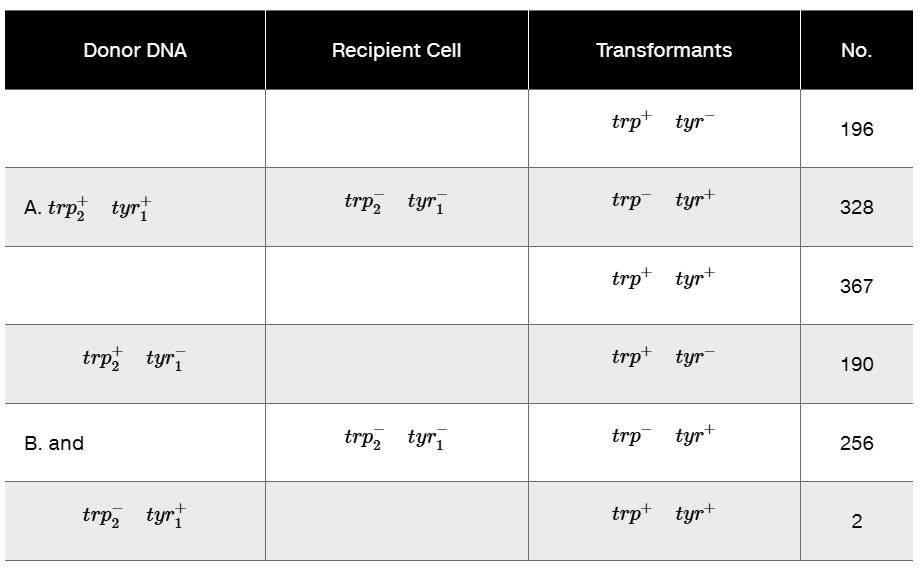
In Bacillus subtilis, linkage analysis of two mutant genes affecting the synthesis of two amino acids, tryptophan (trp₂⁻) and tyrosine (trp₁⁻), was performed using transformation. Examine the following data and draw all possible conclusions regarding linkage. What is the purpose of Part B of the experiment? [Reference: E. Nester, M. Schafer, and J. Lederberg (1963).]
Table showing donor DNA, recipient cell genotypes, transformants, and their counts for bacterial gene linkage analysis.

Guida verificata passo dopo passo
1
Step 1: Understand the experimental setup. In this experiment, Bacillus subtilis is used to study the linkage between two mutant genes affecting the synthesis of tryptophan (trp) and tyrosine (tyr). Transformation is the method used to introduce donor DNA into recipient cells, and the resulting transformants are analyzed for their phenotypes.
Step 2: Analyze the data provided. The table lists the phenotypes of the transformants and their respective numbers. The phenotypes include combinations of wild-type (trp⁺, tyr⁺) and mutant (trp₂⁻, tyr₁⁻) alleles. The numbers indicate the frequency of each phenotype among the transformants.
Step 3: Determine the purpose of Part B of the experiment. Part B involves analyzing specific combinations of donor and recipient DNA to assess the frequency of co-transformation of the trp and tyr genes. This helps determine whether the genes are linked (located close together on the chromosome) or unlinked (located far apart).
Step 4: Use the data to infer linkage. If the trp and tyr genes are linked, co-transformation (simultaneous transfer of both genes) will occur more frequently than expected by chance. Compare the observed frequencies of co-transformed phenotypes (e.g., trp⁺ tyr⁺) to the frequencies of single-gene transformations (e.g., trp⁺ tyr⁻ or trp⁻ tyr⁺).
Step 5: Draw conclusions about linkage. If the frequency of co-transformation is significantly higher than expected for unlinked genes, this suggests that the trp and tyr genes are linked. Conversely, if the frequencies of co-transformation and single-gene transformations are consistent with independent assortment, the genes are likely unlinked.

Risposta video verificata per un problema simile:

Questa soluzione video è stata consigliata dai nostri tutor come utile per risolvere questo problema.
Durata del video:
3m

Concetti chiave

Ecco i concetti essenziali che devi comprendere per rispondere correttamente alla domanda.

Linkage Analysis

Linkage analysis is a genetic technique used to determine the proximity of genes on a chromosome based on the frequency of recombination between them. Genes that are located close to each other tend to be inherited together, while those farther apart are more likely to be separated during meiosis. This method helps in mapping genes and understanding their interactions, particularly in organisms like Bacillus subtilis.
Video consigliato:
Percorso guidato
07:33
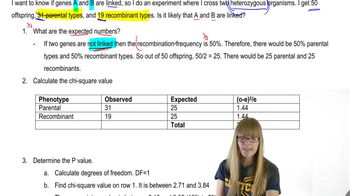
Chi Square and Linkage

Transformation

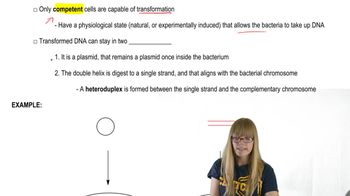
Transformation is a process by which a cell takes up foreign DNA from its environment, leading to genetic changes. In the context of Bacillus subtilis, transformation allows researchers to introduce specific mutations or genes into recipient cells, enabling the study of gene function and interactions. This technique is crucial for analyzing how different genes affect metabolic pathways, such as amino acid synthesis.
Video consigliato:

Amino Acid Synthesis

Amino acid synthesis refers to the biochemical processes through which organisms produce amino acids, the building blocks of proteins. In Bacillus subtilis, specific genes are responsible for the synthesis of amino acids like tryptophan and tyrosine. Understanding the genetic basis of these pathways is essential for interpreting the results of linkage analysis and determining how mutations in these genes affect overall metabolism and growth.
Video consigliato:
Percorso guidato
02:43
Translesion Synthesis
Pratica correlata
Domanda del libro di testo

An Hfr strain is used to map three genes in an interrupted mating experiment. The cross is Hfr/a⁺b⁺c⁺ rif x F⁻/a⁻b⁻c⁻ rifT (No map order is implied in the listing of the alleles; rifT is resistance to the antibiotic rifampicin.) The a⁺ gene is required for the biosynthesis of nutrient A, the b⁺ gene for nutrient B, and the c⁺ gene for nutrient C. The minus alleles are auxotrophs for these nutrients. The cross is initiated at time = 0, and at various times, the mating mixture is plated on three types of medium. Each plate contains minimal medium (MM) plus rifampicin plus specific supplements that are indicated in the following table. (The results for each time interval are shown as the number of colonies growing on each plate.)

What is the purpose of rifampicin in the experiment?

1572
views
1
rank
Domanda del libro di testo

An Hfr strain is used to map three genes in an interrupted mating experiment. The cross is Hfr/a⁺b⁺c⁺ rif x F⁻/a⁻b⁻c⁻ rifT (No map order is implied in the listing of the alleles; rifT is resistance to the antibiotic rifampicin.) The a⁺ gene is required for the biosynthesis of nutrient A, the b⁺ gene for nutrient B, and the c⁺ gene for nutrient C. The minus alleles are auxotrophs for these nutrients. The cross is initiated at time = 0, and at various times, the mating mixture is plated on three types of medium. Each plate contains minimal medium (MM) plus rifampicin plus specific supplements that are indicated in the following table. (The results for each time interval are shown as the number of colonies growing on each plate.)

Based on these data, determine the approximate location on the chromosome of the a, b, and c genes relative to one another and to the F factor.

2507
views
Domanda del libro di testo

In studies of recombination between mutants 1 and 2 from Problem 21, the results shown in the following table were obtained.

Calculate the recombination frequency.

494
views
Domanda del libro di testo

In studies of recombination between mutants 1 and 2 from Problem 21, the results shown in the following table were obtained.

When mutant 6 was tested for recombination with mutant 1, the data were the same as those shown above for strain B, but not for K12. The researcher lost the K12 data but remembered that recombination was ten times more frequent than when mutants 1 and 2 were tested. What were the lost values (dilution and plaque numbers)?

512
views
Domanda del libro di testo

An Hfr strain is used to map three genes in an interrupted mating experiment. The cross is Hfr/a⁺b⁺c⁺ rif x F⁻/a⁻b⁻c⁻ rifT (No map order is implied in the listing of the alleles; rifT is resistance to the antibiotic rifampicin.) The a⁺ gene is required for the biosynthesis of nutrient A, the b⁺ gene for nutrient B, and the c⁺ gene for nutrient C. The minus alleles are auxotrophs for these nutrients. The cross is initiated at time = 0, and at various times, the mating mixture is plated on three types of medium. Each plate contains minimal medium (MM) plus rifampicin plus specific supplements that are indicated in the following table. (The results for each time interval are shown as the number of colonies growing on each plate.)

Can the location of the rif gene be determined in this experiment? If not, design an experiment to determine the location of rif relative to the F factor and to gene b.

606
views
Domanda del libro di testo
In studies of recombination between mutants 1 and 2 from Problem 21, the results shown in the following table were obtained. Strain Dilution Plaques Phenotypes E. coli B 10⁻⁷ 4 r E. coli K12 10⁻² 8 + Mutant 7 (Problem 21) failed to complement any of the other mutants (1–6). Define the nature of mutant 7.
507
views