In this chapter, we have focused on genetic systems present in bacteria and on the viruses that use bacteria as hosts (bacteriophages). In particular, we discussed mechanisms by which bacteria and their phages undergo genetic recombination, which allows geneticists to map bacterial and bacteriophage chromosomes. In the process, we found many opportunities to consider how this information was acquired. From the explanations given in the chapter, what answers would you propose to the following questions? How do we know that intergenic exchange occurs in bacteriophages?
Ch. 6 - Genetic Analysis and Mapping in Bacteria and Bacteriophages

Klug12th EditionConcepts of GeneticsISBN: 9780135564776Non è quello che usi tu?Cambia libro di testo
Tutti i libri di testo
Klug 12th Edition
Ch. 6 - Genetic Analysis and Mapping in Bacteria and Bacteriophages
Problema 1b
Klug 12th Edition
Ch. 6 - Genetic Analysis and Mapping in Bacteria and Bacteriophages
Problema 1bCapitolo 6, Problema 1b
How do we know that bacteria undergo genetic recombination, allowing the transfer of genes from one organism to another?
Guida verificata passo dopo passo1
Understand the concept of genetic recombination in bacteria, which refers to the process where genetic material is exchanged between different bacterial cells, leading to new combinations of genes.
Examine experimental evidence such as the classic experiments by Frederick Griffith, who demonstrated transformation by showing that non-virulent bacteria could acquire virulence traits from dead virulent bacteria, indicating gene transfer.
Consider the process of conjugation, where direct cell-to-cell contact allows the transfer of plasmids or chromosomal DNA between bacteria, providing physical evidence of gene exchange.
Look at transduction, where bacteriophages (viruses that infect bacteria) accidentally transfer bacterial DNA from one cell to another, further supporting the occurrence of genetic recombination.
Analyze genetic mapping experiments in bacteria, where recombination frequencies between genes are measured, confirming that gene transfer and recombination occur and can be quantified.

Risposta video verificata per un problema simile:
Questa soluzione video è stata consigliata dai nostri tutor come utile per risolvere questo problema.
Durata del video:
1mConcetti chiave
Ecco i concetti essenziali che devi comprendere per rispondere correttamente alla domanda.
Genetic Recombination in Bacteria
Genetic recombination in bacteria refers to the process where DNA is exchanged between different bacterial cells, leading to new genetic combinations. This process increases genetic diversity and can occur through mechanisms like transformation, transduction, and conjugation.
Video consigliato:
Percorso guidato
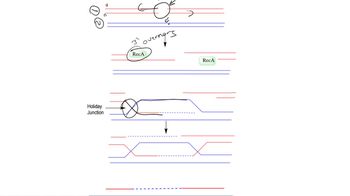
Recombination after Double Strand Breaks
Mechanisms of Gene Transfer
Bacteria transfer genes via three main mechanisms: transformation (uptake of free DNA from the environment), transduction (gene transfer mediated by bacteriophages), and conjugation (direct transfer of DNA through cell-to-cell contact). Each mechanism demonstrates how genetic material moves between organisms.
Video consigliato:
Percorso guidato
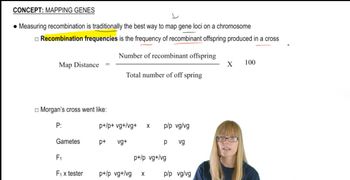
Mapping Genes
Experimental Evidence of Recombination
Experiments such as the Griffith experiment and the Lederberg and Tatum conjugation studies provide evidence for bacterial genetic recombination. These experiments showed that bacteria can acquire new traits by receiving genetic material from other cells, confirming gene transfer and recombination.
Video consigliato:
Percorso guidato
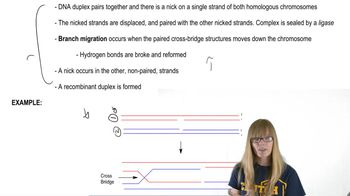
Recombination after Single Strand Breaks
Pratica correlata
Domanda del libro di testo
474
views
Domanda del libro di testo
How do we know that bacteriophages recombine genetic material through transduction and that cell-to-cell contact is not essential for transduction to occur?
531
views
Domanda del libro di testo
How do we know that genes exist in bacteria and bacteriophages?
359
views
Domanda del libro di testo
How do we know whether or not genetic recombination between bacteria involves cell-to-cell contact?
487
views