Ch. 8 - Chromosome Mutations: Variation in Number and Arrangement
Klug - Concepts of Genetics 12th Edition
Klug12th EditionConcepts of GeneticsISBN: 9780135564776Non è quello che usi tu?Cambia libro di testo
Capitolo 8, Problema 30

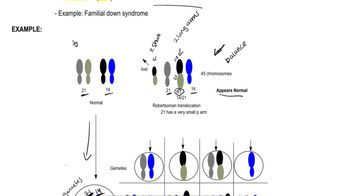
A normal female is discovered with 45 chromosomes, one of which exhibits a Robertsonian translocation containing most of chromosomes 15 and 21. Discuss the possible outcomes in her offspring when her husband contains a normal karyotype.

Guida verificata passo dopo passo
1
Step 1: Understand the nature of the Robertsonian translocation. A Robertsonian translocation occurs when two acrocentric chromosomes fuse near their centromeres, resulting in a single chromosome that contains most of the genetic material from both original chromosomes. In this case, chromosomes 15 and 21 are involved, and the female has 45 chromosomes due to this fusion.
Step 2: Recognize that the female is a balanced carrier. Since she has 45 chromosomes but is phenotypically normal, it means she carries a balanced translocation where no genetic material is lost or gained overall. However, during meiosis, the segregation of this translocation chromosome can produce unbalanced gametes.
Step 3: Analyze the possible meiotic segregation patterns. During gamete formation, the translocation chromosome and the normal homologues of chromosomes 15 and 21 can segregate in different ways, leading to several possible gamete types: normal, balanced translocation carrier, or unbalanced with partial trisomy or monosomy of chromosome 15 or 21 segments.
Step 4: Predict the possible offspring karyotypes when the female's gametes combine with the husband's normal gametes. The offspring could be: (a) normal with 46 chromosomes, (b) balanced translocation carriers like the mother, or (c) have unbalanced chromosomal content leading to conditions such as trisomy 21 (Down syndrome) or other chromosomal imbalances, depending on which segments are duplicated or deleted.
Step 5: Summarize the clinical implications. The risk of miscarriage or offspring with chromosomal disorders is increased due to unbalanced gametes. Genetic counseling and possibly prenatal diagnosis would be recommended to assess the specific risks for this couple.

Risposta video verificata per un problema simile:

Questa soluzione video è stata consigliata dai nostri tutor come utile per risolvere questo problema.
Durata del video:
3m

Concetti chiave

Ecco i concetti essenziali che devi comprendere per rispondere correttamente alla domanda.

Robertsonian Translocation

A Robertsonian translocation is a chromosomal rearrangement where two acrocentric chromosomes fuse at their centromeres, forming a single chromosome. This reduces the chromosome number by one but often retains most genetic material. Carriers are usually phenotypically normal but can produce unbalanced gametes, leading to offspring with chromosomal abnormalities.
Video consigliato:
Percorso guidato
09:31
Robertsonian Translocations

Chromosome Number and Karyotype

Humans typically have 46 chromosomes, arranged in 23 pairs. A karyotype shows the number and structure of chromosomes. A female with 45 chromosomes due to a Robertsonian translocation has one fused chromosome, which can affect segregation during meiosis and influence the chromosomal makeup of her offspring.
Video consigliato:
Percorso guidato
10:35
Human Sex Chromosomes

Genetic Outcomes in Offspring from Translocation Carriers

When a translocation carrier mates with a normal individual, offspring may inherit normal chromosomes, balanced translocations, or unbalanced chromosomal complements. Unbalanced gametes can cause miscarriages or syndromes like Down syndrome if extra genetic material from chromosome 21 is present. Understanding segregation patterns helps predict these outcomes.
Video consigliato:
Percorso guidato
09:31
Robertsonian Translocations
Pratica correlata
Domanda del libro di testo

A boy with Klinefelter syndrome (47,XXY) is born to a mother who is phenotypically normal and a father who has the X-linked skin condition called anhidrotic ectodermal dysplasia. The mother's skin is completely normal with no signs of the skin abnormality. In contrast, her son has patches of normal skin and patches of abnormal skin.

Using the appropriate genetic terminology, explain the son's skin phenotype.

2491
views
Domanda del libro di testo
Most cases of Turner syndrome are attributed to nondisjunction of one or more of the sex chromosomes during gametogenesis, from either the male or female parent. However, some females possess a rare form of Turner syndrome in which some of the cells of the body (somatic cells) lack an X chromosome, while other cells have the normal two X chromosomes. Often detected in blood and/or skin cells, such individuals with mosaic Turner syndrome may exhibit relatively mild symptoms. An individual may be specified as 45,X(20)/46,XX(80) if, for example, 20 percent of the cells examined were X monosomic. How might mitotic events cause such mosaicism, and what parameter(s) would likely determine the percentages and distributions of X0 cells?
1321
views
Domanda del libro di testo

A 3-year-old child exhibited some early indication of Turner syndrome, which results from a 45,X chromosome composition. Karyotypic analysis demonstrated two cell types: 46,XX (normal) and 45,X. Propose a mechanism for the origin of this mosaicism.

881
views