Ch. 8 - Chromosome Mutations: Variation in Number and Arrangement
Klug - Concepts of Genetics 12th Edition
Klug12th EditionConcepts of GeneticsISBN: 9780135564776Non è quello che usi tu?Cambia libro di testo
Capitolo 8, Problema 24a

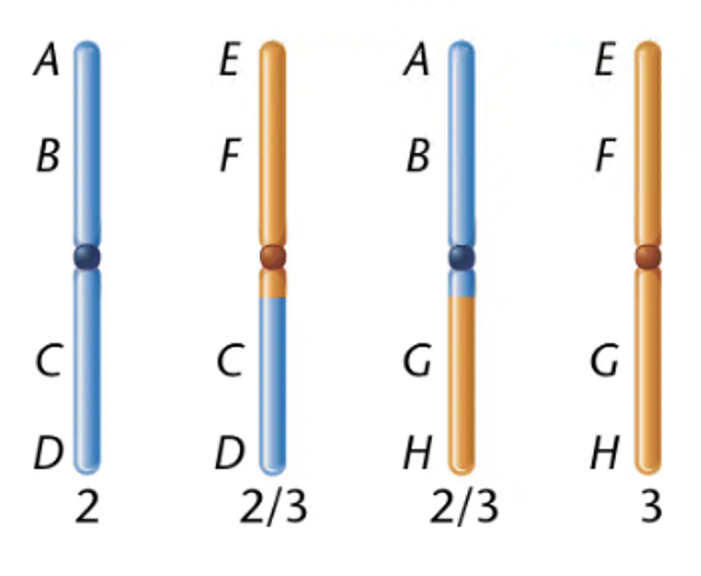
A woman who sought genetic counseling is found to be heterozygous for a chromosomal rearrangement between the second and third chromosomes. Her chromosomes, compared to those in a normal karyotype, are diagrammed to the right.
Diagram showing a heterozygous reciprocal translocation between chromosomes 2 and 3 with exchanged segments.
What kind of chromosomal aberration is shown?

Guida verificata passo dopo passo
1
Step 1: Understand the types of chromosomal rearrangements. Common types include deletions, duplications, inversions, and translocations. Since the rearrangement involves two different chromosomes (chromosomes 2 and 3), focus on translocations.
Step 2: Identify whether the translocation is reciprocal or Robertsonian. Reciprocal translocations involve an exchange of segments between two non-homologous chromosomes without loss of genetic material, while Robertsonian translocations involve fusion of whole long arms of acrocentric chromosomes.
Step 3: Analyze the karyotype diagram to see if segments from chromosome 2 and chromosome 3 have been exchanged. If segments from both chromosomes have swapped places, this indicates a reciprocal translocation.
Step 4: Confirm that the woman is heterozygous for this rearrangement, meaning she has one normal set of chromosomes and one set with the translocation. This is typical for balanced reciprocal translocations where no genetic material is lost or gained.
Step 5: Conclude that the chromosomal aberration shown is a balanced reciprocal translocation between chromosomes 2 and 3, based on the exchange of segments without apparent loss or gain of genetic material.

Risposta video verificata per un problema simile:

Questa soluzione video è stata consigliata dai nostri tutor come utile per risolvere questo problema.
Durata del video:
2m

Concetti chiave

Ecco i concetti essenziali che devi comprendere per rispondere correttamente alla domanda.

Chromosomal Rearrangements

Chromosomal rearrangements involve structural changes in chromosomes, such as deletions, duplications, inversions, or translocations. These changes can alter gene order or dosage and may affect gene function or cause genetic disorders. Understanding the type of rearrangement is key to interpreting karyotype differences.
Video consigliato:
Percorso guidato
04:38
Rearrangement Overview

Heterozygosity for Chromosomal Aberrations

Being heterozygous for a chromosomal rearrangement means one chromosome carries the alteration while the homologous chromosome remains normal. This can lead to complications during meiosis, such as abnormal pairing or segregation, potentially causing infertility or unbalanced gametes.
Video consigliato:
Percorso guidato
08:42
Aberrant Euploid

Types of Chromosomal Aberrations: Translocation vs. Inversion

Common chromosomal aberrations include translocations, where segments are exchanged between nonhomologous chromosomes, and inversions, where a chromosome segment is reversed within the same chromosome. Identifying whether the rearrangement involves two chromosomes or a segment flipped within one helps classify the aberration.
Video consigliato:
Percorso guidato
12:42
Reciprocal Translocation
Pratica correlata
Domanda del libro di testo

A woman who sought genetic counseling is found to be heterozygous for a chromosomal rearrangement between the second and third chromosomes. Her chromosomes, compared to those in a normal karyotype, are diagrammed to the right.

Using a drawing, demonstrate how these chromosomes would pair during meiosis. Be sure to label the different segments of the chromosomes.

480
views
Domanda del libro di testo

A woman who sought genetic counseling is found to be heterozygous for a chromosomal rearrangement between the second and third chromosomes. Her chromosomes, compared to those in a normal karyotype, are diagrammed to the right.

This woman is phenotypically normal. Does this surprise you? Why or why not? Under what circumstances might you expect a phenotypic effect of such a rearrangement?

628
views
Domanda del libro di testo

A couple planning their family are aware that through the past three generations on the husband's side a substantial number of stillbirths have occurred and several malformed babies were born who died early in childhood. The wife has studied genetics and urges her husband to visit a genetic counseling clinic, where a complete karyotype-banding analysis is performed. Although the tests show that he has a normal complement of 46 chromosomes, banding analysis reveals that one member of the chromosome 1 pair (in group A) contains an inversion covering 70 percent of its length. The homolog of chromosome 1 and all other chromosomes show the normal banding sequence.

Would you advise the woman that she will have to bring each pregnancy to term to determine whether the fetus is normal? If not, what else can you suggest?

449
views
Domanda del libro di testo

A couple planning their family are aware that through the past three generations on the husband's side a substantial number of stillbirths have occurred and several malformed babies were born who died early in childhood. The wife has studied genetics and urges her husband to visit a genetic counseling clinic, where a complete karyotype-banding analysis is performed. Although the tests show that he has a normal complement of 46 chromosomes, banding analysis reveals that one member of the chromosome 1 pair (in group A) contains an inversion covering 70 percent of its length. The homolog of chromosome 1 and all other chromosomes show the normal banding sequence.

What can you predict about the probability of abnormality/normality of their future children?

430
views
Domanda del libro di testo

In a cross in Drosophila, a female heterozygous for the autosomally linked genes a, b, c, d, and e (abcde/ +++++) was testcrossed with a male homozygous for all recessive alleles. Even though the distance between each of the loci was at least 3 map units, only four phenotypes were recovered, yielding the following data:

Why are many expected crossover phenotypes missing? Can any of these loci be mapped from the data given here? If so, determine map distances.

878
views
Domanda del libro di testo

The woman in Problem 24 has had two miscarriages. She has come to you, an established genetic counselor, with these questions:

Is there a genetic explanation of her frequent miscarriages?

Should she abandon her attempts to have a child of her own?

If not, what is the chance that she could have a normal child? Provide an informed response to her concerns.

616
views