Ch. 9 - Extranuclear Inheritance
Klug - Concepts of Genetics 12th Edition
Klug12th EditionConcepts of GeneticsISBN: 9780135564776Non è quello che usi tu?Cambia libro di testo
Capitolo 9, Problema 1d

In the discussion, we focused on extranuclear inheritance and how traits can be determined by genetic information contained in mitochondria and chloroplasts, and we discussed how expression of maternal genotypes can affect the phenotype of an organism. At the same time, we found many opportunities to consider the methods and reasoning by which much of this information was acquired. From the explanations given in the chapter, what answers would you propose to the following fundamental questions?
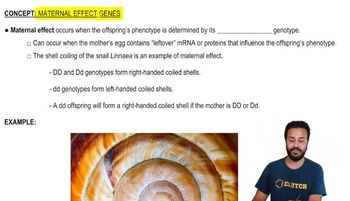
What key observations in crosses between dextrally and sinistrally coiled snails support the explanation that this phenotype is the result of maternal-effect inheritance?

Guida verificata passo dopo passo
1
Understand the concept of maternal-effect inheritance: Maternal-effect inheritance occurs when the phenotype of an organism is determined by the genotype of its mother, rather than its own genotype. This is often due to substances deposited in the egg by the mother during oogenesis.
Review the phenotype of dextrally and sinistrally coiled snails: Dextrally coiled snails have shells that coil to the right, while sinistrally coiled snails have shells that coil to the left. These traits are influenced by maternal-effect inheritance.
Examine the key observation in snail crosses: When a dextral female snail is crossed with a sinistral male snail, all offspring exhibit dextral coiling, regardless of their own genotype. Conversely, when a sinistral female snail is crossed with a dextral male snail, all offspring exhibit sinistral coiling.
Analyze the reasoning behind maternal-effect inheritance: The phenotype of the offspring is determined by the genotype of the mother because the mother’s genotype influences the cytoplasmic factors deposited in the egg, which direct early development and determine coiling direction.
Conclude with the evidence supporting maternal-effect inheritance: The consistent correlation between the mother’s genotype and the offspring’s phenotype, regardless of the offspring’s own genotype, strongly supports the explanation that coiling direction in snails is a result of maternal-effect inheritance.

Risposta video verificata per un problema simile:

Questa soluzione video è stata consigliata dai nostri tutor come utile per risolvere questo problema.
Durata del video:
40s

Concetti chiave

Ecco i concetti essenziali che devi comprendere per rispondere correttamente alla domanda.

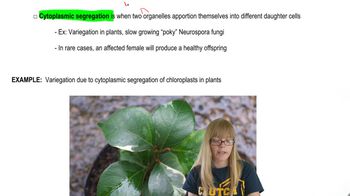
Extranuclear Inheritance

Extranuclear inheritance refers to the transmission of genetic material that occurs outside the nucleus, primarily through organelles like mitochondria and chloroplasts. This type of inheritance is distinct from Mendelian inheritance, as it does not follow the typical patterns of segregation and independent assortment. In organisms, traits influenced by extranuclear genes can be inherited maternally, meaning they are passed from mother to offspring through the cytoplasm of the egg.
Video consigliato:
Percorso guidato
05:13
Organelle Inheritance

Maternal Effect

Maternal effect is a phenomenon where the genotype of the mother directly influences the phenotype of her offspring, regardless of the offspring's own genotype. This occurs because the mother provides cytoplasmic factors, such as RNAs and proteins, that affect early development. In the case of the coiling direction in snails, the maternal genotype determines the phenotype of the offspring, illustrating how maternal contributions can shape traits.
Video consigliato:
Percorso guidato
03:38
Maternal Effect

Phenotypic Expression in Snails

The phenotypic expression of traits in organisms, such as the coiling direction of snails, can be influenced by genetic factors from both nuclear and extranuclear sources. In dextrally and sinistrally coiled snails, the observed phenotypes can be traced back to the maternal genotype, which provides the necessary cytoplasmic determinants. Key observations in crosses, such as consistent coiling direction in offspring regardless of paternal genotype, support the concept of maternal-effect inheritance.
Video consigliato:
Percorso guidato
02:09
Penetrance and Expressivity
Pratica correlata
Domanda del libro di testo

Write a short essay that distinguishes between organelle heredity and maternal effect.

506
views
Domanda del libro di testo

Streptomycin resistance in Chlamydomonas may result from a mutation in either a chloroplast gene or a nuclear gene. What phenotypic results would occur in a cross between a member of an mt⁺ strain resistant in both genes and a member of a strain sensitive to the antibiotic? What results would occur in the reciprocal cross?

1786
views
Domanda del libro di testo

In the discussion, we focused on extranuclear inheritance and how traits can be determined by genetic information contained in mitochondria and chloroplasts, and we discussed how expression of maternal genotypes can affect the phenotype of an organism. At the same time, we found many opportunities to consider the methods and reasoning by which much of this information was acquired. From the explanations given in the chapter, what answers would you propose to the following fundamental questions?

What observations support the endosymbiotic theory?

462
views
Domanda del libro di testo

In the discussion, we focused on extranuclear inheritance and how traits can be determined by genetic information contained in mitochondria and chloroplasts, and we discussed how expression of maternal genotypes can affect the phenotype of an organism. At the same time, we found many opportunities to consider the methods and reasoning by which much of this information was acquired. From the explanations given in the chapter, what answers would you propose to the following fundamental questions?

What findings demonstrate a maternal effect as the basis of a mode of inheritance?

546
views
Domanda del libro di testo

How was it established that particular phenotypes are inherited as a result of genetic information present in the chloroplast rather than in the nucleus?

424
views
Domanda del libro di testo

In the discussion, we focused on extranuclear inheritance and how traits can be determined by genetic information contained in mitochondria and chloroplasts, and we discussed how expression of maternal genotypes can affect the phenotype of an organism. At the same time, we found many opportunities to consider the methods and reasoning by which much of this information was acquired. From the explanations given in the chapter, what answers would you propose to the following fundamental questions?

How did the discovery of three categories of petite mutations in yeast lead researchers to postulate extranuclear inheritance of colony size?

575
views