
Ch. 9 - Extranuclear Inheritance
Klug - Concepts of Genetics 12th Edition
Klug12th EditionConcepts of GeneticsISBN: 9780135564776Non è quello che usi tu?Cambia libro di testo
Capitolo 9, Problema 19b

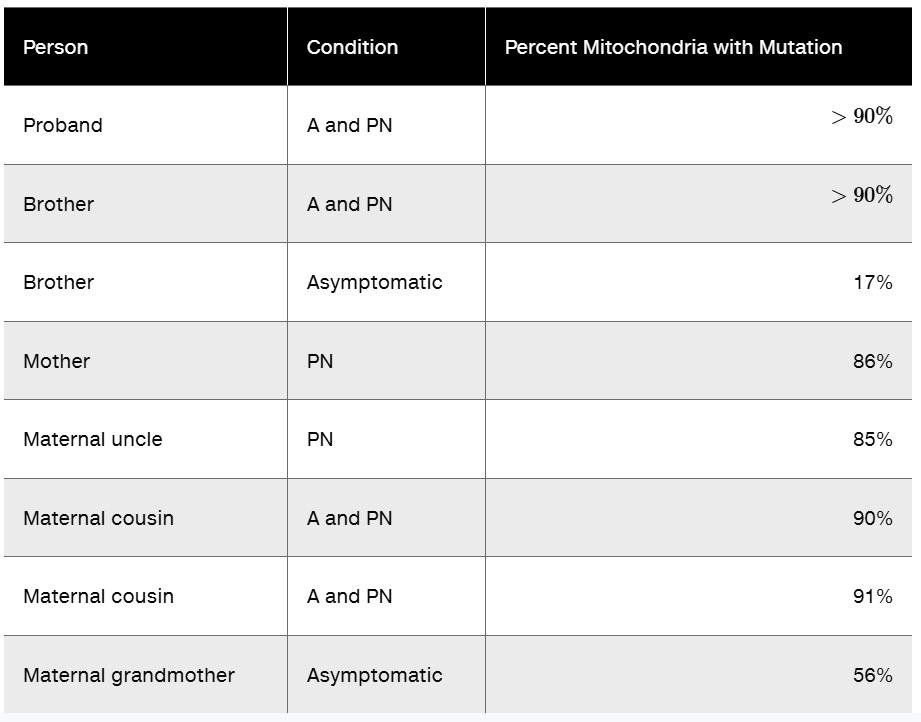
Researchers examined a family with an interesting distribution of Leigh syndrome symptoms. In this disorder, individuals may show a progressive loss of motor function (ataxia, A) with peripheral neuropathy (PN, meaning impairment of the peripheral nerves). A mitochondrial DNA (mtDNA) mutation that reduces ATPase activity was identified in various tissues of affected individuals. The accompanying table summarizes the presence of symptoms in an extended family.
Table showing family members with Leigh syndrome symptoms and mitochondrial mutation percentages indicating maternal inheritance.
Provide an explanation for the pattern of inheritance of the disease. What term describes this pattern?

Guida verificata passo dopo passo
1
Step 1: Recognize that the disorder described in the problem is associated with mitochondrial DNA (mtDNA). Mitochondrial DNA is inherited maternally, meaning it is passed down from the mother to all her offspring, regardless of their sex.
Step 2: Note the variability in symptoms and the percentage of mitochondria with the mutation in different individuals. This variability is due to heteroplasmy, a condition where cells contain a mixture of normal and mutated mtDNA. The proportion of mutated mtDNA can influence the severity of symptoms.
Step 3: Observe that individuals with a higher percentage of mutated mtDNA (>90%) exhibit more severe symptoms (ataxia and peripheral neuropathy), while those with lower percentages (e.g., 17% or 56%) are asymptomatic or have milder symptoms. This demonstrates a threshold effect, where symptoms manifest only when the proportion of mutated mtDNA exceeds a certain level.
Step 4: Identify the pattern of inheritance as maternal inheritance, as the mutation is passed down through the maternal line (e.g., mother, maternal uncle, maternal cousins, and maternal grandmother). This is consistent with the inheritance of mitochondrial DNA.
Step 5: Conclude that the term describing this pattern of inheritance is 'mitochondrial inheritance,' which is characterized by maternal transmission and variability in symptom severity due to heteroplasmy and the threshold effect.

Risposta video verificata per un problema simile:

Questa soluzione video è stata consigliata dai nostri tutor come utile per risolvere questo problema.
Durata del video:
3m

Concetti chiave

Ecco i concetti essenziali che devi comprendere per rispondere correttamente alla domanda.

Mitochondrial Inheritance

Mitochondrial inheritance refers to the transmission of genetic traits through mitochondrial DNA (mtDNA), which is inherited exclusively from the mother. This pattern of inheritance is significant because mutations in mtDNA can lead to various disorders, such as Leigh syndrome, affecting energy production in cells. In families with mitochondrial disorders, all offspring of an affected mother may show symptoms, while fathers do not pass on mtDNA.
Video consigliato:
Percorso guidato
05:13
Organelle Inheritance

Leigh Syndrome

Leigh syndrome is a severe neurological disorder characterized by progressive loss of mental and movement abilities, often leading to early death. It is associated with mitochondrial dysfunction, particularly affecting ATP production due to mutations in mtDNA. Symptoms can vary widely among individuals, even within the same family, highlighting the complexity of mitochondrial diseases and their expression.
Video consigliato:
Percorso guidato
09:31
Robertsonian Translocations

Penetrance and Expressivity

Penetrance refers to the proportion of individuals with a specific genotype that actually express the associated phenotype, while expressivity describes the degree to which a phenotype is expressed. In the context of Leigh syndrome, the varying percentages of mitochondria with mutations among family members illustrate differences in penetrance and expressivity, leading to some individuals being asymptomatic despite carrying the mutation.
Video consigliato:
Percorso guidato
02:09
Penetrance and Expressivity
Pratica correlata
Domanda del libro di testo

Mutations in mitochondrial DNA appear to be responsible for a number of neurological disorders, including myoclonic epilepsy and ragged-red fiber disease, Leber's hereditary optic neuropathy, and Kearns-Sayre syndrome. In each case, the disease phenotype is expressed when the ratio of mutant to wild-type mitochondria exceeds a threshold peculiar to each disease, but usually in the 60 to 95 percent range.

Given that these are debilitating conditions, why has no cure been developed? Can you suggest a general approach that might be used to treat, or perhaps even cure, these disorders?

874
views
Domanda del libro di testo

Payne, B. A. et al. (2013) present evidence that a low level of heteroplasmic mtDNA exists in all tested healthy individuals.

What are two likely sources of such heteroplasmy?

359
views
Domanda del libro di testo

Researchers examined a family with an interesting distribution of Leigh syndrome symptoms. In this disorder, individuals may show a progressive loss of motor function (ataxia, A) with peripheral neuropathy (PN, meaning impairment of the peripheral nerves). A mitochondrial DNA (mtDNA) mutation that reduces ATPase activity was identified in various tissues of affected individuals. The accompanying table summarizes the presence of symptoms in an extended family.

How can some individuals in the same family show such variation in symptoms? What term, as related to organelle heredity, describes such variation?

535
views
Domanda del libro di testo

Researchers examined a family with an interesting distribution of Leigh syndrome symptoms. In this disorder, individuals may show a progressive loss of motor function (ataxia, A) with peripheral neuropathy (PN, meaning impairment of the peripheral nerves). A mitochondrial DNA (mtDNA) mutation that reduces ATPase activity was identified in various tissues of affected individuals. The accompanying table summarizes the presence of symptoms in an extended family.

Develop a pedigree that summarizes the information presented in the table.

519
views
Domanda del libro di testo

Researchers examined a family with an interesting distribution of Leigh syndrome symptoms. In this disorder, individuals may show a progressive loss of motor function (ataxia, A) with peripheral neuropathy (PN, meaning impairment of the peripheral nerves). A mitochondrial DNA (mtDNA) mutation that reduces ATPase activity was identified in various tissues of affected individuals. The accompanying table summarizes the presence of symptoms in an extended family.

In what way does a condition caused by mtDNA differ in expression and transmission from a mutation that causes albinism?

480
views
Domanda del libro di testo

Mutations in mitochondrial DNA appear to be responsible for a number of neurological disorders, including myoclonic epilepsy and ragged-red fiber disease, Leber's hereditary optic neuropathy, and Kearns-Sayre syndrome. In each case, the disease phenotype is expressed when the ratio of mutant to wild-type mitochondria exceeds a threshold peculiar to each disease, but usually in the 60 to 95 percent range.

Compared with the vast number of mitochondria in an embryo, the number of mitochondria in an ovum is relatively small. Might such an ooplasmic mitochondrial bottleneck present an opportunity for therapy or cure? Explain.

860
views