Ch. 11 - Gene Mutation, DNA Repair, and Homologous Recombination
Sanders - Genetic Analysis: An Integrated Approach 3rd Edition
Sanders3rd EditionGenetic Analysis: An Integrated ApproachISBN: 9780135564172Non è quello che usi tu?Cambia libro di testo
Capitolo 11, Problema 40c

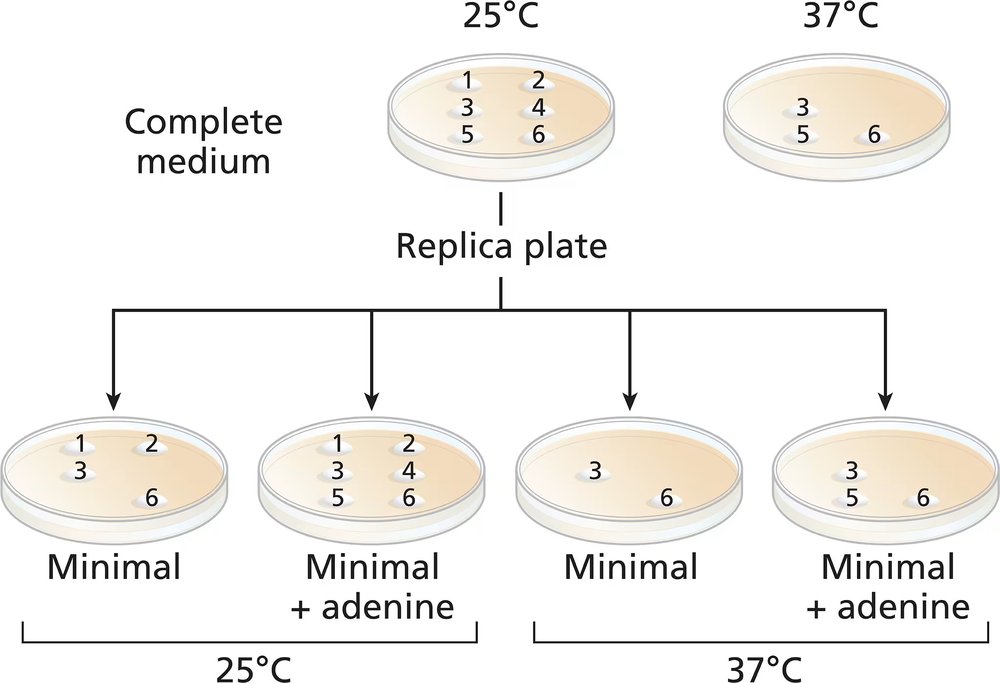
Common baker's yeast (Saccharomyces cerevisiae) is normally grown at 37°C, but it will grow actively at temperatures down to approximately 25°C. A haploid culture of wild-type yeast is mutagenized with EMS. Cells from the mutagenized culture are spread on a complete-medium plate and grown at 25°C. Six colonies (1 to 6) are selected from the original complete-medium plate and transferred to two fresh complete-medium plates. The new complete plates (shown) are grown at 25°C and 37°C. Four replica plates are made onto minimal medium or minimal plus adenine from the 25°C complete-medium plate. The new plates are grown at either 25°C or 37°C and the growth results are shown.
Diagram showing yeast colonies on complete medium and replica plates at 25°C and 37°C, indicating growth patterns.
What can you say about colony 4?

Guida verificata passo dopo passo
1
Step 1: Understand the experimental setup. The yeast cells were mutagenized with EMS (ethyl methanesulfonate), a chemical mutagen that induces point mutations. Colonies were grown at two different temperatures (25°C and 37°C) and on different media types (complete medium, minimal medium, and minimal medium supplemented with adenine). The goal is to analyze the growth patterns of colony 4 under these conditions.
Step 2: Analyze the growth results for colony 4. Check whether colony 4 grows on complete medium at both 25°C and 37°C. This will help determine if the mutation affects its ability to grow at different temperatures.
Step 3: Examine the growth of colony 4 on minimal medium at both temperatures. If colony 4 fails to grow on minimal medium but grows on minimal medium supplemented with adenine, it suggests that the mutation affects adenine biosynthesis, making it an adenine auxotroph.
Step 4: Consider the temperature sensitivity of colony 4. If colony 4 grows at 25°C but not at 37°C, it indicates that the mutation is temperature-sensitive, meaning the gene product is functional at lower temperatures but not at higher temperatures.
Step 5: Conclude the analysis. Based on the growth patterns across the different media and temperatures, colony 4 is likely a temperature-sensitive adenine auxotroph. This means it requires adenine supplementation for growth and exhibits a temperature-sensitive phenotype.

Risposta video verificata per un problema simile:

Questa soluzione video è stata consigliata dai nostri tutor come utile per risolvere questo problema.
Durata del video:
4m

Concetti chiave

Ecco i concetti essenziali che devi comprendere per rispondere correttamente alla domanda.

Haploidy and Mutagenesis

Haploidy refers to cells that contain a single set of chromosomes, which is typical for certain yeast species like Saccharomyces cerevisiae. Mutagenesis is the process of inducing mutations in an organism's DNA, often using chemical agents like ethyl methanesulfonate (EMS). This process can lead to various phenotypic changes, which can be analyzed to understand gene function and interactions.
Video consigliato:
Percorso guidato
02:45
Haploid Genetics

Temperature Effects on Yeast Growth

Temperature significantly influences the growth and metabolic activity of yeast. Saccharomyces cerevisiae thrives at optimal temperatures around 30-37°C but can still grow at lower temperatures, such as 25°C. Understanding how temperature affects yeast growth is crucial for interpreting experimental results, especially when assessing the viability of colonies under different conditions.
Video consigliato:
Percorso guidato
03:38
Maternal Effect

Minimal Medium and Nutritional Requirements

Minimal medium is a growth medium that contains only the essential nutrients required for the organism to grow, excluding any additional supplements. In yeast, specific nutrients like adenine may be added to support growth in mutants that have lost the ability to synthesize certain compounds. Analyzing growth on minimal versus complete media helps determine the nutritional requirements and metabolic capabilities of different yeast colonies.
Video consigliato:
Percorso guidato
04:06
Conjugation Overview
Pratica correlata
Domanda del libro di testo

Thinking back to the discussion of gain-of-function and loss-of-function mutations, explain why gain-of-function mutations are often dominant and why loss-of-function mutations are often recessive. Give an example of a type of gain-of-function mutation that is dominant and of a loss-of-function mutation that is recessive.

734
views
Domanda del libro di testo

The two gels illustrated contain dideoxynucleotide DNA-sequencing information for a wild-type segment and mutant segment of DNA corresponding to the N-terminal end of a protein. The start codon and the next five codons are sequenced.

Write the DNA sequence of both alleles, including strand polarity.

554
views
Domanda del libro di testo

Common baker's yeast (Saccharomyces cerevisiae) is normally grown at 37°C, but it will grow actively at temperatures down to approximately 25°C. A haploid culture of wild-type yeast is mutagenized with EMS. Cells from the mutagenized culture are spread on a complete-medium plate and grown at 25°C. Six colonies (1 to 6) are selected from the original complete-medium plate and transferred to two fresh complete-medium plates. The new complete plates (shown) are grown at 25°C and 37°C. Four replica plates are made onto minimal medium or minimal plus adenine from the 25°C complete-medium plate. The new plates are grown at either 25°C or 37°C and the growth results are shown.

Classify the nature of the mutations in colonies 1, 2, and 5.

460
views
Domanda del libro di testo

The two gels illustrated contain dideoxynucleotide DNA-sequencing information for a wild-type segment and mutant segment of DNA corresponding to the N-terminal end of a protein. The start codon and the next five codons are sequenced.

Identify the template and nontemplate strands of DNA.

605
views
Domanda del libro di testo

Common baker's yeast (Saccharomyces cerevisiae) is normally grown at 37°C, but it will grow actively at temperatures down to approximately 25°C. A haploid culture of wild-type yeast is mutagenized with EMS. Cells from the mutagenized culture are spread on a complete-medium plate and grown at 25°C. Six colonies (1 to 6) are selected from the original complete-medium plate and transferred to two fresh complete-medium plates. The new complete plates (shown) are grown at 25°C and 37°C. Four replica plates are made onto minimal medium or minimal plus adenine from the 25°C complete-medium plate. The new plates are grown at either 25°C or 37°C and the growth results are shown.

Which colonies are prototrophic and which are auxotrophic? What growth information is used to make these determinations?

609
views
Domanda del libro di testo

The two gels illustrated contain dideoxynucleotide DNA-sequencing information for a wild-type segment and mutant segment of DNA corresponding to the N-terminal end of a protein. The start codon and the next five codons are sequenced.

Write out the mRNA sequences encoded by each template strand, and underline the start codons.

587
views