Ch. 12 - Regulation of Gene Expression in Bacteria and Bacteriophage
Sanders - Genetic Analysis: An Integrated Approach 3rd Edition
Sanders3rd EditionGenetic Analysis: An Integrated ApproachISBN: 9780135564172Non è quello che usi tu?Cambia libro di testo
Capitolo 12, Problema 8

The CAP binding site in the lac promoter is the location of positive regulation of gene expression for the operon. Identify what binds at this site to produce positive regulation, under what circumstances binding occurs, and how binding exerts a positive effect.

Guida verificata passo dopo passo
1
Identify the molecule that binds to the CAP binding site: The molecule that binds to the CAP binding site is the catabolite activator protein (CAP), also known as cAMP receptor protein (CRP).
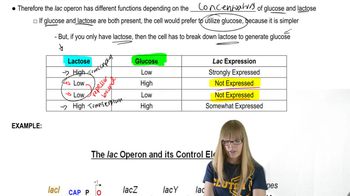
Determine the circumstances under which CAP binds to the site: CAP binds to the CAP binding site when it is complexed with cyclic AMP (cAMP). This occurs when glucose levels are low, leading to an increase in cAMP levels.
Explain how the binding of CAP-cAMP complex occurs: The CAP-cAMP complex binds to the CAP binding site located upstream of the lac operon promoter.
Describe the effect of CAP-cAMP binding on gene expression: The binding of the CAP-cAMP complex facilitates the binding of RNA polymerase to the promoter, enhancing the transcription of the lac operon genes.
Summarize the overall impact of CAP-cAMP binding: The positive regulation by CAP-cAMP ensures that the lac operon is expressed when glucose is scarce and lactose is available, allowing the cell to utilize lactose as an energy source.

Risposta video verificata per un problema simile:

Questa soluzione video è stata consigliata dai nostri tutor come utile per risolvere questo problema.
Durata del video:
3m

Concetti chiave

Ecco i concetti essenziali che devi comprendere per rispondere correttamente alla domanda.

CAP Protein

The CAP (catabolite activator protein) is a transcription factor that binds to the CAP binding site in the lac promoter. This protein is crucial for the positive regulation of the lac operon, as it enhances the binding of RNA polymerase to the promoter, facilitating the transcription of genes involved in lactose metabolism.
Video consigliato:

cAMP Levels

Cyclic AMP (cAMP) is a signaling molecule that plays a vital role in the regulation of the lac operon. When glucose levels are low, cAMP levels rise, leading to the activation of CAP. The binding of cAMP to CAP is necessary for CAP to attach to the CAP binding site, thus promoting gene expression in the presence of lactose.
Video consigliato:
Percorso guidato
07:01
Lac Operon Summary

Positive Regulation

Positive regulation refers to the process by which a regulatory protein, such as CAP, increases the likelihood of transcription of a gene. In the case of the lac operon, when CAP binds to the CAP binding site in the presence of cAMP, it enhances RNA polymerase's affinity for the promoter, leading to increased transcription of the operon genes, especially when lactose is available.
Video consigliato:
Percorso guidato
07:
Positional Cloning