Ch. 15 - Recombinant DNA Technology and Its Applications
Sanders - Genetic Analysis: An Integrated Approach 3rd Edition
Sanders3rd EditionGenetic Analysis: An Integrated ApproachISBN: 9780135564172Non è quello che usi tu?Cambia libro di testo
Capitolo 15, Problema 32

About 1% of occurrences of nonautoimmune type 1 diabetes are due to loss-of-function alleles in the insulin gene. Individuals heterozygous for such mutations develop diabetes as infants or in the first few years of their lives. Outline how you might approach gene therapy for such a disease and what difficulties you might encounter.

Guida verificata passo dopo passo
1
Begin by identifying the specific loss-of-function mutation in the insulin gene that is responsible for the nonautoimmune type 1 diabetes in the patient. This involves sequencing the insulin gene to pinpoint the exact mutation.
Select an appropriate vector for delivering the correct version of the insulin gene to the patient's cells. Common vectors include viral vectors like lentivirus or adeno-associated virus (AAV), which are often used in gene therapy due to their efficiency in gene delivery.
Construct a therapeutic gene that includes the correct version of the insulin gene, along with necessary regulatory elements to ensure proper expression in the target cells. This construct should be inserted into the chosen vector.
Determine the specific cell types that need to be targeted for therapy. In the case of insulin, this would likely involve pancreatic beta cells, which are responsible for insulin production. Ensure that the vector can effectively deliver the gene to these cells.
Consider potential challenges such as immune responses to the vector, ensuring long-term expression of the gene, and avoiding insertional mutagenesis. Develop strategies to mitigate these issues, such as using immune-suppressive treatments or designing vectors with improved safety profiles.>

Risposta video verificata per un problema simile:

Questa soluzione video è stata consigliata dai nostri tutor come utile per risolvere questo problema.
Durata del video:
1m

Concetti chiave

Ecco i concetti essenziali che devi comprendere per rispondere correttamente alla domanda.

Gene Therapy

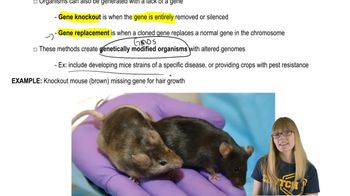
Gene therapy involves the introduction, removal, or alteration of genetic material within a person's cells to treat or prevent disease. In the context of type 1 diabetes caused by insulin gene mutations, gene therapy could aim to deliver a functional copy of the insulin gene to pancreatic cells, potentially restoring insulin production. This approach requires precise delivery methods and safety considerations to avoid unintended effects.
Video consigliato:
Percorso guidato
09:12
Transgenic Organisms and Gene Therapy

Loss-of-Function Alleles

Loss-of-function alleles are mutations that result in reduced or abolished protein function. In the case of the insulin gene, such mutations can lead to insufficient insulin production, causing diabetes. Understanding the specific mutations involved is crucial for designing targeted gene therapies that can effectively compensate for the loss of function.
Video consigliato:
Percorso guidato
08:26
Functional Genomics

Challenges in Gene Therapy

Gene therapy faces several challenges, including delivery mechanisms, immune responses, and long-term expression of the therapeutic gene. For type 1 diabetes, ensuring that the delivered gene reaches the correct cells and functions properly is critical. Additionally, the risk of immune reactions against the introduced genetic material or the modified cells can complicate treatment outcomes.
Video consigliato:
Percorso guidato
09:12
Transgenic Organisms and Gene Therapy
Pratica correlata
Domanda del libro di testo

You have cloned a gene for an enzyme that degrades lipids in a bacterium that normally lives in cold temperatures. You wish to transfer this gene into E. coli to produce industrial amounts of enzyme for use in laundry detergent.

How would you accomplish this?

494
views
Domanda del libro di testo

The RAS gene encodes a signaling protein that hydrolyzes GTP to GDP. When bound by GDP, the RAS protein is inactive, whereas when bound by GTP, RAS protein activates a target protein, resulting in stimulation of cells to actively grow and divide. As shown in the accompanying sequence, a single base-pair mutation results in a mutant protein that is constitutively active, leading to continual promotion of cell proliferation. Such mutations play a role in the formation of cancer. You have cloned the wild-type version of the mouse RAS gene and wish to create a mutant form to study its biological activity in vitro and in transgenic mice. Outline how you would proceed.

800
views
Domanda del libro di testo

Would a gene drive system spread rapidly through a population in a species that tends to self-mate (e.g., Arabidopsis, C. elegans)? In a species in which the breeding cycle is slow (e.g., humans)?

517
views
Domanda del libro di testo

Describe how having the Cas9 gene at a genomic locus unlinked to the guide RNA and target site locus in an engineered gene drive system could slow the propagation of the gene drive allele in a population into which a small number of individuals carrying both the gene drive allele and the Cas9 locus are released.

473
views
Domanda del libro di testo

You have cloned a gene for an enzyme that degrades lipids in a bacterium that normally lives in cold temperatures. You wish to transfer this gene into E. coli to produce industrial amounts of enzyme for use in laundry detergent.

You have managed to produce transgenic E. coli expressing mRNA of your gene, but only a low level of protein is produced. Why might this be so? How could you overcome this problem?

532
views