Ch. 9 - The Molecular Biology of Translation
Sanders - Genetic Analysis: An Integrated Approach 3rd Edition
Sanders3rd EditionGenetic Analysis: An Integrated ApproachISBN: 9780135564172Non è quello che usi tu?Cambia libro di testo
Capitolo 9, Problema 39e

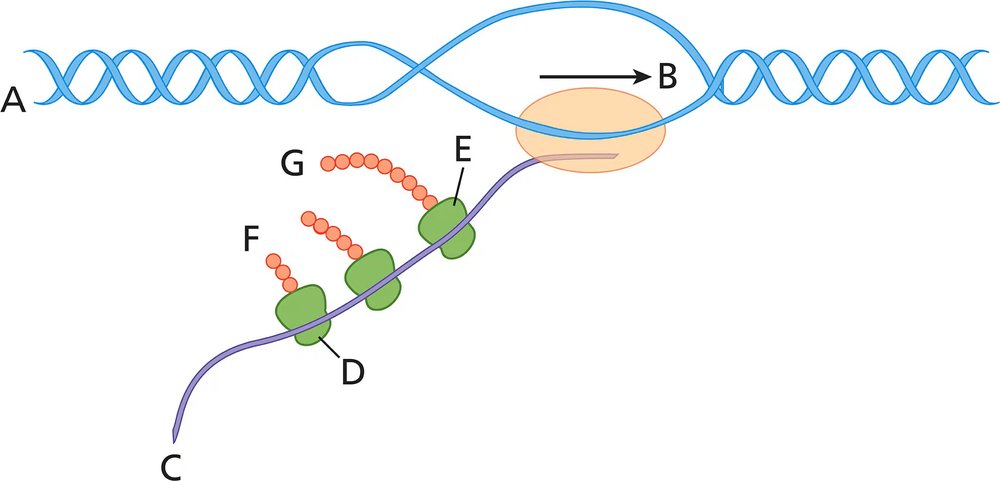
Answer the following questions about the accompanying diagram.
Diagram illustrating a DNA strand with labeled components A, B, C, D, E, F, G, showing transcription process.
Which end of the molecule is closest to C?

Guida verificata passo dopo passo
1
Examine the accompanying diagram carefully to identify the molecular structure being referenced. Determine whether the molecule is DNA, RNA, or a protein based on its features.
Identify the orientation of the molecule. For nucleic acids like DNA or RNA, this typically involves recognizing the 5' and 3' ends of the strand. For proteins, it may involve identifying the N-terminus and C-terminus.
Locate the position of 'C' in the diagram. This could refer to a specific base (e.g., cytosine in nucleic acids), a carbon atom in a sugar-phosphate backbone, or another structural feature.
Determine which end of the molecule (e.g., 5' or 3' for nucleic acids, or N-terminus or C-terminus for proteins) is closest to the position of 'C' based on the spatial arrangement in the diagram.
Conclude the orientation by referencing the structural features and labeling conventions provided in the diagram, ensuring clarity in identifying the closest end to 'C'.

Risposta video verificata per un problema simile:

Questa soluzione video è stata consigliata dai nostri tutor come utile per risolvere questo problema.
Durata del video:
1m

Concetti chiave

Ecco i concetti essenziali che devi comprendere per rispondere correttamente alla domanda.

Molecular Structure

Understanding the molecular structure is crucial for interpreting diagrams in genetics. Molecules, such as DNA or RNA, have distinct ends, often referred to as the 5' and 3' ends, which are important for their function and interactions. Recognizing these ends helps in determining the orientation and directionality of the molecule.
Video consigliato:
Percorso guidato
03:49
Ribosome Structure

Nucleotide Composition

Nucleotides are the building blocks of nucleic acids, consisting of a sugar, a phosphate group, and a nitrogenous base. The specific arrangement of these components influences the properties and behavior of the molecule. Identifying the components at each end of the molecule is essential for answering questions about its structure and function.
Video consigliato:
Percorso guidato
06:51
Human Genome Composition

Diagram Interpretation

Interpreting diagrams in genetics requires the ability to analyze visual representations of molecular structures. This includes recognizing labels, directional arrows, and other annotations that indicate specific features of the molecule. Effective diagram interpretation is key to answering questions related to molecular orientation and relationships.
Video consigliato: