Skip to main content
GOB Chemistry
Il mio corso
Impara
Preparazione agli esami
AI Tutor
Guide di studio
Soluzioni per libri di testo
Flashcard
Esplora
Prova l'app
Il mio corso
Impara
Preparazione agli esami
AI Tutor
Guide di studio
Soluzioni per libri di testo
Flashcard
Esplora
Prova l'app
Indietro
Alcohol Reactions: Dehydration Reactions quiz
Puoi toccare per girare la carta.
What is the main reagent used in the dehydration of alcohols to form alkenes?
Puoi toccare per girare la carta.
👆
What is the main reagent used in the dehydration of alcohols to form alkenes?
Sulfuric acid (H2SO4) is the main reagent used in the dehydration of alcohols to form alkenes.
Avanzamenti del tracciato
I pulsanti di controllo sono stati cambiati in modalità "navigazione".
1/15
Flashcard correlate
Pratica correlata
Video consigliati
Alcohol Reactions: Dehydration Reactions definitions
Alcohol Reactions: Dehydration Reactions
13 Termini
Alcohol Reactions: Dehydration Reactions
14. Compounds with Oxygen or Sulfur
6 Problemi
Argomento
Jules
Intro to Redox Reactions
14. Compounds with Oxygen or Sulfur
3 Problemi
Argomento
Ernest
14. Compounds with Oxygen or Sulfur
7 Argomenti
15 Problemi
Capitolo
Jules
VideoThumbView.guidedCourse
1:30
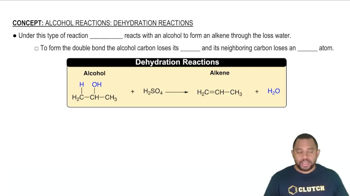
Alcohol Reactions: Dehydration Reactions Concept 1
1575
views
6
rank
VideoThumbView.guidedCourse
1:24
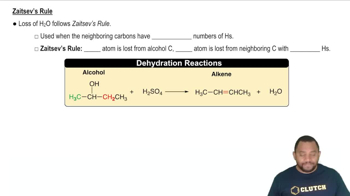
Zaitsev’s Rule Concept 2
1650
views
5
rank
VideoThumbView.guidedCourse
1:13
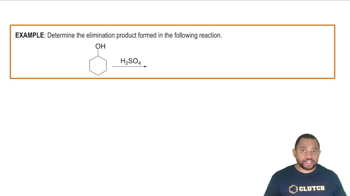
Alcohol Reactions Dehydration Reactions Example 1
1538
views
10
rank
Termini in questo insieme (15)
Nascondere definizioni
What is the main reagent used in the dehydration of alcohols to form alkenes?
Sulfuric acid (H2SO4) is the main reagent used in the dehydration of alcohols to form alkenes.
What is lost from the alcohol molecule during a dehydration reaction?
A water molecule (H2O) is lost from the alcohol during a dehydration reaction.
Which atom is lost from the alcohol carbon in a dehydration reaction?
The OH group is lost from the alcohol carbon.
From which neighboring carbon is the hydrogen atom lost during dehydration?
The hydrogen atom is lost from a neighboring carbon adjacent to the alcohol carbon.
What type of bond is formed between the alcohol carbon and its neighbor after dehydration?
A double bond (alkene) is formed between the alcohol carbon and its neighboring carbon.
What happens if the neighboring carbons to the alcohol carbon are identical in a dehydration reaction?
If the neighboring carbons are identical, the hydrogen can be lost from either side.
What rule is used to determine which hydrogen is lost when neighboring carbons are different?
Zaitsev's rule is used to determine which hydrogen is lost.
According to Zaitsev's rule, from which carbon is the hydrogen lost?
The hydrogen is lost from the neighboring carbon with fewer hydrogens.
Why must the alcohol carbon and its neighbor form a double bond after dehydration?
They must form a double bond to maintain four bonds for each carbon after losing OH and H.
What is the product of a dehydration reaction of an alcohol?
The product is an alkene.
What is the role of sulfuric acid in the dehydration reaction?
Sulfuric acid acts as a catalyst to promote the loss of water and formation of the alkene.
What is the significance of Zaitsev's rule in dehydration reactions?
Zaitsev's rule ensures the most substituted (stable) alkene is formed by removing H from the carbon with fewer hydrogens.
What happens to the structure of the alcohol after the loss of OH and H?
The alcohol carbon and its neighbor each lose a bond and form a double bond with each other.
In a dehydration reaction, what must be true about the number of bonds each carbon has after the reaction?
Each carbon must still have four bonds after the reaction.
When is Zaitsev's rule not needed in a dehydration reaction?
Zaitsev's rule is not needed when the neighboring carbons are identical, as the hydrogen can be lost from either side.
 IndietroIndietro

 1:30
1:30