Skip to main content
GOB Chemistry
Il mio corso
Impara
Preparazione agli esami
AI Tutor
Guide di studio
Soluzioni per libri di testo
Flashcard
Esplora
Prova l'app
Il mio corso
Impara
Preparazione agli esami
AI Tutor
Guide di studio
Soluzioni per libri di testo
Flashcard
Esplora
Prova l'app
Indietro
Beta Decay definitions
Puoi toccare per girare la carta.
Beta Decay
Puoi toccare per girare la carta.
👆
Beta Decay
A process where an unstable nucleus releases a beta particle, changing its atomic number but not its atomic mass.
Avanzamenti del tracciato
I pulsanti di controllo sono stati cambiati in modalità "navigazione".
1/15
Flashcard correlate
Pratica correlata
Video consigliati
Beta Decay quiz
Beta Decay
15 Termini
Beta Decay
11. Nuclear Chemistry
3 Problemi
Argomento
Jules
Gamma Emission
11. Nuclear Chemistry
3 Problemi
Argomento
Jules
11. Nuclear Chemistry - Part 1 of 2
4 Argomenti
9 Problemi
Capitolo
Jules
11. Nuclear Chemistry - Part 2 of 2
4 Argomenti
9 Problemi
Capitolo
Jules
VideoThumbView.guidedCourse
02:32
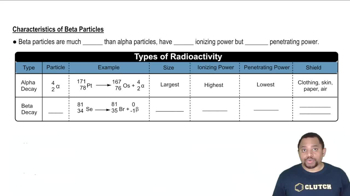
Characteristics of Beta Particles
3973
views
16
rank
VideoThumbView.guidedCourse
01:02
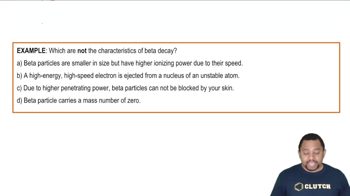
Characteristics of Beta Particles Example
4075
views
25
rank
2
comments
VideoThumbView.guidedCourse
03:01
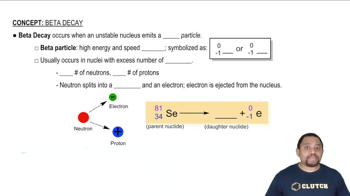
Beta Decay
4291
views
19
rank
Termini in questo insieme (15)
Nascondere definizioni
Beta Decay
A process where an unstable nucleus releases a beta particle, changing its atomic number but not its atomic mass.
Beta Particle
A subatomic particle identical to an electron, emitted from a nucleus during radioactive transformation.
Electron
A negatively charged subatomic particle with negligible mass, represented by atomic number -1 in nuclear equations.
Atomic Mass
The total number of protons and neutrons in a nucleus, remaining unchanged during beta decay.
Atomic Number
A value indicating the number of protons in a nucleus, which increases by one after beta emission.
Nucleus
The dense central region of an atom where beta decay originates, containing protons and neutrons.
Radioactive Particle
A general term for particles, such as alpha or beta, emitted during nuclear transformations.
Alpha Particle
A large, highly ionizing radioactive particle, more damaging but less penetrating than a beta particle.
Ionizing Power
A measure of a particle's ability to remove electrons from atoms, lower for beta particles than for alpha particles.
Penetrating Power
A property describing how deeply a particle can pass through materials, higher for beta particles than for alpha particles.
Nuclear Equation
A symbolic representation showing the balance of atomic numbers and masses before and after a nuclear event.
Product
A substance or particle that appears on the right side of a nuclear equation, such as a beta particle in beta emission.
Reactant
A substance or particle present on the left side of a nuclear equation, involved before the transformation.
Periodic Table
A chart organizing elements by atomic number, used to identify elements formed during nuclear changes.
Thallium-201
An isotope formed when mercury-201 undergoes beta decay, having an atomic number one greater than mercury.
 IndietroIndietro
 02:32
02:32