Skip to main content
GOB Chemistry
Il mio corso
Impara
Preparazione agli esami
AI Tutor
Guide di studio
Soluzioni per libri di testo
Flashcard
Esplora
Prova l'app
Il mio corso
Impara
Preparazione agli esami
AI Tutor
Guide di studio
Soluzioni per libri di testo
Flashcard
Esplora
Prova l'app
Indietro
Enzyme Classification quiz
Puoi toccare per girare la carta.
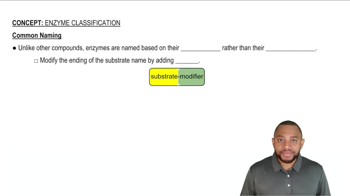
What is the common naming convention for enzymes?
Puoi toccare per girare la carta.
👆
What is the common naming convention for enzymes?
Enzymes are commonly named by adding 'ase' to the substrate name, reflecting their function rather than structure.
Avanzamenti del tracciato
I pulsanti di controllo sono stati cambiati in modalità "navigazione".
1/15
Flashcard correlate
Pratica correlata
Video consigliati
Enzyme Classification definitions
Enzyme Classification
15 Termini
Enzyme Classification
19. Enzymes
7 Problemi
Argomento
KeyshawnDavis
Enzyme-Substrate Complex
19. Enzymes
4 Problemi
Argomento
Nicole
19. Enzymes
9 Argomenti
15 Problemi
Capitolo
Laura
VideoThumbView.guidedCourse
1:06
Lyases Example 7
3093
views
3
rank
VideoThumbView.guidedCourse
0:39
Common Naming Concept 1
3468
views
5
rank
VideoThumbView.guidedCourse
1:26
Six Main Classifications Concept 3
3432
views
6
rank
Termini in questo insieme (15)
Nascondere definizioni
What is the common naming convention for enzymes?
Enzymes are commonly named by adding 'ase' to the substrate name, reflecting their function rather than structure.
How are enzymes systematically named?
Systematic names include the substrate followed by the enzyme class, indicating both the substrate and the type of reaction catalyzed.
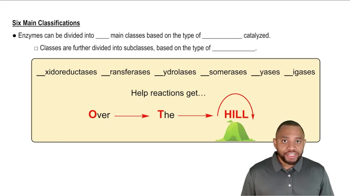
How many main classes of enzymes are there and what are they based on?
There are six main classes of enzymes, categorized based on the type of reaction they catalyze.
What type of reaction do oxidoreductases catalyze?
Oxidoreductases catalyze oxidation-reduction (redox) reactions by transferring electrons between molecules.
Name two subclasses of oxidoreductases and their functions.
Oxidases oxidize a substance, while reductases reduce a substance.
What is the main function of transferases?
Transferases catalyze the transfer of functional groups between molecules.
What functional group do kinases transfer?
Kinases transfer phosphate groups between molecules.
What reaction do hydrolases catalyze?
Hydrolases catalyze hydrolysis reactions, breaking bonds by adding water.
List four subclasses of hydrolases and what they act on.
Lipases act on lipids, proteases on proteins, nucleases on nucleic acids, and phosphatases on phosphate ester bonds.
What is the function of isomerases?
Isomerases catalyze the rearrangement of atoms within a molecule to create isomers.
Do isomerases have subclasses?
No, isomerases do not have specific subclasses.
What do lyases do in biochemical reactions?
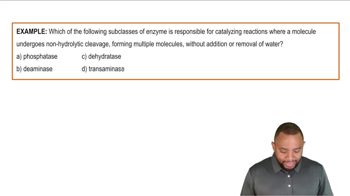
Lyases catalyze the addition or removal of groups to form or break double bonds, without involving hydrolysis or redox reactions.
Name three subclasses of lyases and their specific functions.
Dehydrogenases remove water, deaminases remove amino groups, and decarboxylases remove carbon dioxide.
What is the main function of ligases?
Ligases catalyze the covalent bonding of two molecules using ATP.
What are the two main subclasses of ligases and what do they do?
Synthetases form bonds between two molecules, while carboxylases specifically add CO2 to another molecule.
 IndietroIndietro
 1:06
1:06