Skip to main content
GOB Chemistry
Il mio corso
Impara
Preparazione agli esami
AI Tutor
Guide di studio
Soluzioni per libri di testo
Flashcard
Esplora
Prova l'app
Il mio corso
Impara
Preparazione agli esami
AI Tutor
Guide di studio
Soluzioni per libri di testo
Flashcard
Esplora
Prova l'app
Indietro
Enzyme Inhibition definitions
Puoi toccare per girare la carta.
Enzyme Inhibition
Puoi toccare per girare la carta.
👆
Enzyme Inhibition
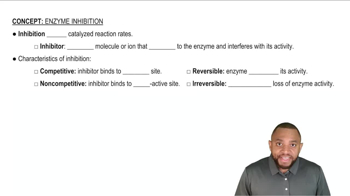
A process that decreases the rate of catalyzed reactions by interfering with enzyme activity through inhibitor binding.
Avanzamenti del tracciato
I pulsanti di controllo sono stati cambiati in modalità "navigazione".
1/15
Flashcard correlate
Pratica correlata
Video consigliati
Enzyme Inhibition quiz
Enzyme Inhibition
15 Termini
Enzyme Inhibition
19. Enzymes
7 Problemi
Argomento
Laura
Enzyme Regulation: Allosteric Control
19. Enzymes
1 problema
Argomento
Laura
19. Enzymes
9 Argomenti
15 Problemi
Capitolo
Laura
VideoThumbView.guidedCourse
2:04
Enzyme Inhibition Example 1
3350
views
2
rank
VideoThumbView.guidedCourse
1:19
Enzyme Inhibition Concept 1
3365
views
2
rank
VideoThumbView.guidedCourse
3:26
Enzyme Inhibition Concept 2
3408
views
2
rank
Termini in questo insieme (15)
Nascondere definizioni
Enzyme Inhibition
A process that decreases the rate of catalyzed reactions by interfering with enzyme activity through inhibitor binding.
Inhibitor
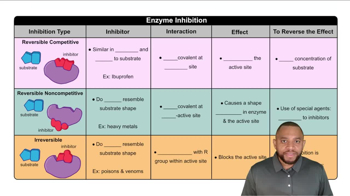
A small molecule or ion that attaches to an enzyme, reducing its effectiveness by blocking or altering its active or non-active site.
Active Site
A region on an enzyme where the substrate binds and the catalytic reaction occurs; often targeted by competitive inhibitors.
Competitive Inhibition
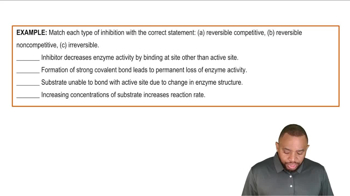
A type of interference where a molecule similar in shape and size to the substrate occupies the active site, preventing substrate access.
Noncompetitive Inhibition
A form of interference where a molecule binds to a site other than the active site, causing a shape change that reduces enzyme activity.
Allosteric Site
A region on an enzyme, distinct from the active site, where noncompetitive inhibitors bind to induce conformational changes.
Reversible Inhibition
A temporary decrease in enzyme activity that can be undone by increasing substrate concentration or using special agents.
Irreversible Inhibition
A permanent loss of enzyme function, often due to covalent attachment of an inhibitor, as seen with poisons or venoms.
Substrate
A molecule that binds to the active site of an enzyme and undergoes a chemical transformation during the reaction.
Covalent Interaction
A strong chemical bond formed between an inhibitor and an enzyme, typically resulting in permanent inhibition.
Noncovalent Interaction
A reversible and weaker association between an inhibitor and an enzyme, common in reversible inhibition.
Shape Change
A structural alteration in an enzyme, often induced by noncompetitive inhibitors, that reduces substrate binding efficiency.
Heavy Metals
Elements that commonly act as noncompetitive inhibitors by binding to non-active sites and altering enzyme structure.
Ibuprofen
A pharmaceutical example of a competitive inhibitor that blocks the active site of specific enzymes.
Venoms
Toxic substances that can cause irreversible inhibition by permanently disabling enzyme activity through covalent binding.
 IndietroIndietro
 2:04
2:04