Skip to main content
GOB Chemistry
Il mio corso
Impara
Preparazione agli esami
AI Tutor
Guide di studio
Soluzioni per libri di testo
Flashcard
Esplora
Prova l'app
Il mio corso
Impara
Preparazione agli esami
AI Tutor
Guide di studio
Soluzioni per libri di testo
Flashcard
Esplora
Prova l'app
Indietro
Gamma Emission definitions
Puoi toccare per girare la carta.
Gamma Radiation
Puoi toccare per girare la carta.
👆
Gamma Radiation
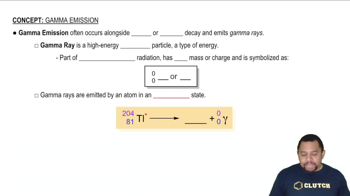
A form of electromagnetic energy with the highest frequency and energy, and the shortest wavelength, capable of penetrating most materials.
Avanzamenti del tracciato
I pulsanti di controllo sono stati cambiati in modalità "navigazione".
1/15
Flashcard correlate
Pratica correlata
Video consigliati
Gamma Emission quiz
Gamma Emission
15 Termini
Gamma Emission
11. Nuclear Chemistry
3 Problemi
Argomento
Jules
Electron Capture & Positron Emission
11. Nuclear Chemistry
4 Problemi
Argomento
Jules
11. Nuclear Chemistry - Part 1 of 2
4 Argomenti
9 Problemi
Capitolo
Jules
11. Nuclear Chemistry - Part 2 of 2
4 Argomenti
9 Problemi
Capitolo
Jules
VideoThumbView.guidedCourse
01:21
Characteristics of Gamma Rays Example
148
views
6
rank
VideoThumbView.guidedCourse
02:02
Gamma Emission
3931
views
7
rank
VideoThumbView.guidedCourse
01:35
Characteristics of Gamma Rays
4075
views
12
rank
Termini in questo insieme (15)
Nascondere definizioni
Gamma Radiation
A form of electromagnetic energy with the highest frequency and energy, and the shortest wavelength, capable of penetrating most materials.
Electromagnetic Spectrum
A range of all types of electromagnetic radiation, ordered by frequency and wavelength, including gamma rays at the high-energy end.
Wavelength
The distance between consecutive wave crests; shorter values indicate higher energy and frequency in electromagnetic waves.
Frequency
The number of wave cycles passing a point per second; higher values correspond to higher energy in electromagnetic radiation.
Energy
A property directly proportional to frequency and inversely proportional to wavelength in electromagnetic waves.
Cosmic Rays
High-energy radiation from outer space, possessing even greater energy than gamma rays within the electromagnetic spectrum.
Gamma Emission
A process where an atom releases excess energy, often after electron excitation, without altering atomic mass or number.
Excited State
A condition where an electron has absorbed energy and occupies a higher energy orbital than its ground state.
Ionizing Power
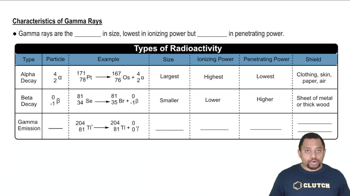
The ability of radiation to remove electrons from atoms; lower for gamma rays compared to other radiation types.
Penetrating Power
The capacity of radiation to pass through materials; highest for gamma rays, making them hazardous to living tissue.
Atomic Mass
A value representing the total number of protons and neutrons in an atom, unchanged during gamma emission.
Atomic Number
A value indicating the number of protons in an atom, remaining constant during gamma emission.
Electron Configuration
The arrangement of electrons in an atom's orbitals, which can show changes due to energy absorption and excitation.
Orbital
A region around an atom's nucleus where electrons are likely to be found, with electrons jumping to higher ones upon excitation.
Living Tissue
Biological material highly susceptible to damage from penetrating radiation such as gamma rays.
 IndietroIndietro
 01:21
01:21