Skip to main content
GOB Chemistry
Il mio corso
Impara
Preparazione agli esami
AI Tutor
Guide di studio
Soluzioni per libri di testo
Flashcard
Esplora
Prova l'app
Il mio corso
Impara
Preparazione agli esami
AI Tutor
Guide di studio
Soluzioni per libri di testo
Flashcard
Esplora
Prova l'app
Indietro
Gluconeogenesis quiz
Puoi toccare per girare la carta.
What is the main purpose of gluconeogenesis?
Puoi toccare per girare la carta.
👆
What is the main purpose of gluconeogenesis?
The main purpose of gluconeogenesis is to convert pyruvate into glucose.
Avanzamenti del tracciato
I pulsanti di controllo sono stati cambiati in modalità "navigazione".
1/15
Flashcard correlate
Pratica correlata
Video consigliati
Gluconeogenesis definitions
Gluconeogenesis
15 Termini
Gluconeogenesis
22. Carbohydrate Metabolism
5 Problemi
Argomento
Nicole
Intro to Gluconeogenesis
22. Carbohydrate Metabolism
2 Problemi
Argomento
Nicole
22. Carbohydrate Metabolism
9 Argomenti
15 Problemi
Capitolo
Nicole
VideoThumbView.guidedCourse
1:13
Gluconeogenesis Concept 3
1830
views
VideoThumbView.guidedCourse
2:01
Gluconeogenesis Example 5
1786
views
VideoThumbView.guidedCourse
1:12
Gluconeogenesis Concept 5
1854
views
Termini in questo insieme (15)
Nascondere definizioni
What is the main purpose of gluconeogenesis?
The main purpose of gluconeogenesis is to convert pyruvate into glucose.
How many biochemical reactions are involved in gluconeogenesis?
Gluconeogenesis involves a total of 11 biochemical reactions.
Which reactions in gluconeogenesis differ from glycolysis?
Reactions 1, 2, 9, and 11 in gluconeogenesis are different from those in glycolysis.
What enzyme catalyzes the conversion of pyruvate to oxaloacetate in gluconeogenesis?
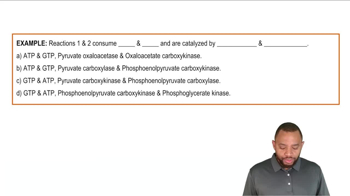
Pyruvate carboxylase catalyzes the conversion of pyruvate to oxaloacetate.
Which enzyme is responsible for converting oxaloacetate to phosphoenolpyruvate (PEP)?
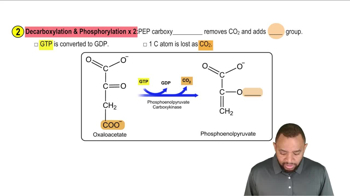
PEP carboxykinase is responsible for converting oxaloacetate to phosphoenolpyruvate (PEP).
What is the role of fructose 1,6-bisphosphatase in gluconeogenesis?
Fructose 1,6-bisphosphatase removes an inorganic phosphate from fructose 1,6-bisphosphate to form fructose 6-phosphate.
Which enzyme catalyzes the final step of gluconeogenesis, forming glucose?
Glucose 6-phosphatase catalyzes the final step, removing a phosphate from glucose 6-phosphate to form glucose.
What energy molecules are required for gluconeogenesis?
Gluconeogenesis requires ATP, GTP, and NADH to drive its reactions.
What mnemonic helps remember the reactions in gluconeogenesis that differ from glycolysis?
The mnemonic 'call 911' helps remember that reactions 1, 2, 9, and 11 are different.
What is the sequence of key metabolites in gluconeogenesis according to the mnemonic?
The sequence is pyruvate, oxaloacetate, PEP, fructose 1,6-bisphosphate, fructose 6-phosphate, glucose 6-phosphate, and glucose.
How does the Cori cycle connect muscle and liver metabolism?
The Cori cycle transports lactate from muscles to the liver, where it is converted back to glucose via gluconeogenesis.
Which reactions in gluconeogenesis involve the use of ATP or GTP?
Reaction 1 uses ATP, reaction 2 uses GTP, and reaction 5 uses ATP.
What class of enzyme is responsible for transferring phosphate groups in gluconeogenesis?
Kinases are the class of enzymes responsible for transferring phosphate groups.
What is the function of isomerase enzymes in gluconeogenesis?
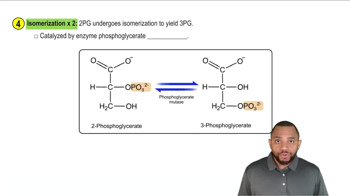
Isomerase enzymes catalyze the rearrangement of molecules to form isomers, such as converting fructose 6-phosphate to glucose 6-phosphate.
How does glycerol enter the gluconeogenesis pathway?
Glycerol enters gluconeogenesis as dihydroxyacetone phosphate (DHAP), bypassing the pyruvate step.
 IndietroIndietro
 1:13
1:13