Skip to main content
GOB Chemistry
Il mio corso
Impara
Preparazione agli esami
AI Tutor
Guide di studio
Soluzioni per libri di testo
Flashcard
Esplora
Prova l'app
Il mio corso
Impara
Preparazione agli esami
AI Tutor
Guide di studio
Soluzioni per libri di testo
Flashcard
Esplora
Prova l'app
Indietro
Intro to Carbohydrate Metabolism quiz
1 Lo studente ha trovato utile questo
Puoi toccare per girare la carta.
What is the initial step in harvesting energy from carbohydrates?
Puoi toccare per girare la carta.
👆
What is the initial step in harvesting energy from carbohydrates?
The initial step is digestion, which converts food into small molecules through mechanical and biochemical breakdown.
Avanzamenti del tracciato
I pulsanti di controllo sono stati cambiati in modalità "navigazione".
1/15
Flashcard correlate
Pratica correlata
Video consigliati
Intro to Carbohydrate Metabolism definitions
Intro to Carbohydrate Metabolism
15 Termini
Intro to Carbohydrate Metabolism
22. Carbohydrate Metabolism
5 Problemi
Argomento
Nicole
Intro to Glycolysis
22. Carbohydrate Metabolism
1 problema
Argomento
Nicole
22. Carbohydrate Metabolism
9 Argomenti
15 Problemi
Capitolo
Nicole
VideoThumbView.guidedCourse
1:51
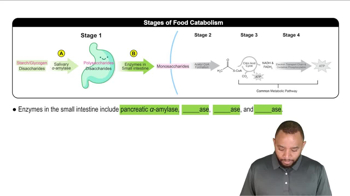
Intro To Carbohydrate Metabolism Concept 2
928
views
1
rank
VideoThumbView.guidedCourse
0:50
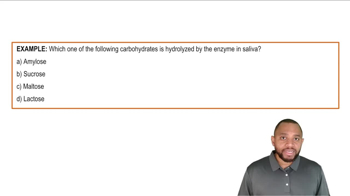
Intro To Carbohydrate Metabolism Example 1
879
views
1
rank
VideoThumbView.guidedCourse
1:53
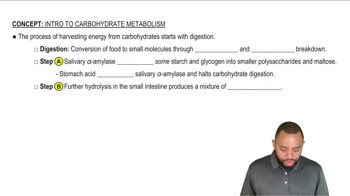
Intro To Carbohydrate Metabolism Concept 1
970
views
1
rank
Termini in questo insieme (15)
Nascondere definizioni
What is the initial step in harvesting energy from carbohydrates?
The initial step is digestion, which converts food into small molecules through mechanical and biochemical breakdown.
What does mechanical breakdown in digestion refer to?
Mechanical breakdown refers to chewing and grinding food into smaller molecules.
What is biochemical breakdown in carbohydrate digestion?
Biochemical breakdown uses hydrolysis to break down large molecules into smaller molecules.
Which enzyme starts the breakdown of starch and glycogen in the mouth?
Salivary Alpha Amylase starts the breakdown of starch and glycogen into smaller polysaccharides and maltose.
What are polysaccharides?
Polysaccharides are polymers of glucose, consisting of several glucose molecules connected by glycosidic linkages.
What is maltose?
Maltose is a disaccharide made of two glucose molecules connected by a glycosidic linkage.
What are oligosaccharides and how are they produced?
Oligosaccharides are chains of 3 to 10 monosaccharides, produced through the hydrolysis of glycogen and starch.
What happens to salivary alpha amylase in the stomach?
Stomach acid inactivates salivary alpha amylase, halting carbohydrate digestion.
Does the stomach secrete enzymes for carbohydrate hydrolysis?
No, the stomach does not secrete enzymes for carbohydrate hydrolysis.
Where does further hydrolysis of carbohydrates occur after the stomach?
Further hydrolysis occurs in the small intestines.
Which enzymes in the small intestine break down carbohydrates?
Pancreatic alpha amylase, maltase, sucrase, and lactase break down carbohydrates in the small intestine.
What monosaccharides are produced from carbohydrate digestion in the small intestine?
Glucose, fructose, and galactose are produced from carbohydrate digestion in the small intestine.
What are the stages following carbohydrate digestion leading to energy production?
The stages are Acetyl CoA formation, the Krebs cycle, and the electron transport chain.
What molecules are produced during the Krebs cycle?
The Krebs cycle produces ATP, NADH, FADH2, and carbon dioxide.
What is the common metabolic pathway in carbohydrate metabolism?
The common metabolic pathway includes the Krebs cycle and oxidative phosphorylation, crucial for energy production from carbohydrates.
 IndietroIndietro
 1:51
1:51