Skip to main content
GOB Chemistry
Il mio corso
Impara
Preparazione agli esami
AI Tutor
Guide di studio
Soluzioni per libri di testo
Flashcard
Esplora
Prova l'app
Il mio corso
Impara
Preparazione agli esami
AI Tutor
Guide di studio
Soluzioni per libri di testo
Flashcard
Esplora
Prova l'app
Indietro
Intro to Gluconeogenesis quiz
Puoi toccare per girare la carta.
What is gluconeogenesis?
Puoi toccare per girare la carta.
👆
What is gluconeogenesis?
Gluconeogenesis is the synthesis of glucose from non-carbohydrate sources, especially when blood glucose is low.
Avanzamenti del tracciato
I pulsanti di controllo sono stati cambiati in modalità "navigazione".
1/15
Flashcard correlate
Pratica correlata
Video consigliati
Intro to Gluconeogenesis definitions
Intro to Gluconeogenesis
14 Termini
Intro to Gluconeogenesis
22. Carbohydrate Metabolism
2 Problemi
Argomento
Nicole
Gluconeogenesis
22. Carbohydrate Metabolism
5 Problemi
Argomento
Nicole
22. Carbohydrate Metabolism
9 Argomenti
15 Problemi
Capitolo
Nicole
VideoThumbView.guidedCourse
1:31
Intro to Gluconeogenesis Example 1
1272
views
2
rank
VideoThumbView.guidedCourse
1:45
Intro to Gluconeogenesis Concept 1
1334
views
VideoThumbView.guidedCourse
1:03
Intro to Gluconeogenesis Concept 2
1309
views
Termini in questo insieme (15)
Nascondere definizioni
What is gluconeogenesis?
Gluconeogenesis is the synthesis of glucose from non-carbohydrate sources, especially when blood glucose is low.
When is gluconeogenesis most active?
It is most active when dietary carbohydrates are low or during fasting.
Why is gluconeogenesis important for the brain?
Because glucose is the primary energy source for the brain, especially when dietary intake is insufficient.
Where does gluconeogenesis primarily occur?
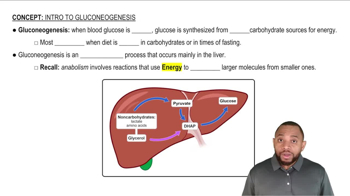
Gluconeogenesis mainly occurs in the liver.
Is gluconeogenesis an anabolic or catabolic process?
It is an anabolic process, meaning it uses energy to build larger molecules from smaller ones.
What are two main non-carbohydrate sources for gluconeogenesis?
Lactate and amino acids are two main non-carbohydrate sources.
How are lactate and amino acids used in gluconeogenesis?
They are converted into pyruvate, which can then be transformed into DHAP and eventually into glucose.
What is DHAP and its role in gluconeogenesis?
DHAP stands for dihydroxyacetone phosphate and is an intermediate that can be converted into glucose.
How does glycerol contribute to gluconeogenesis?
Glycerol is converted into DHAP, which then helps in the synthesis of glucose.
What are the two ways the body can obtain glucose?
The body can obtain glucose by eating carbohydrates or by synthesizing it through gluconeogenesis.
How is gluconeogenesis related to glycolysis?
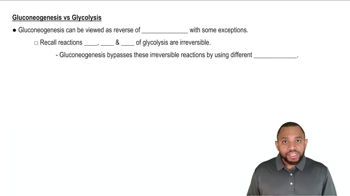
Gluconeogenesis is essentially the reverse of glycolysis, but it bypasses certain irreversible steps.
What are the irreversible reactions in glycolysis?
Reactions 1, 3, and 10 in glycolysis are irreversible.
How does gluconeogenesis bypass irreversible glycolysis steps?
It uses different enzymes to bypass the irreversible reactions.
When are gluconeogenesis-specific enzymes upregulated?
These enzymes are upregulated when blood glucose levels are low.
What is the main purpose of gluconeogenesis during fasting?
Its main purpose is to maintain adequate glucose levels for energy, especially for the brain.
 IndietroIndietro
 1:31
1:31