Skip to main content
GOB Chemistry
Il mio corso
Impara
Preparazione agli esami
AI Tutor
Guide di studio
Soluzioni per libri di testo
Flashcard
Esplora
Prova l'app
Il mio corso
Impara
Preparazione agli esami
AI Tutor
Guide di studio
Soluzioni per libri di testo
Flashcard
Esplora
Prova l'app
Indietro
Intro to Lipid Digestion quiz
Puoi toccare per girare la carta.
What are triacylglycerols (TAGs) and why are they important in the diet?
Puoi toccare per girare la carta.
👆
What are triacylglycerols (TAGs) and why are they important in the diet?
TAGs are the most abundant dietary lipids and serve as a rich source of energy.
Avanzamenti del tracciato
I pulsanti di controllo sono stati cambiati in modalità "navigazione".
1/15
Flashcard correlate
Pratica correlata
Video consigliati
Intro to Lipid Digestion definitions
Intro to Lipid Digestion
14 Termini
Intro to Lipid Digestion quiz
Intro to Lipid Digestion
15 Termini
Intro to Lipid Digestion
24. Lipid Metabolism
2 Problemi
Argomento
KeyshawnDavis
Digestion of Lipids
24. Lipid Metabolism
3 Problemi
Argomento
Nicole
24. Lipid Metabolism - Part 1 of 2
8 Argomenti
15 Problemi
Capitolo
KeyshawnDavis
24. Lipid Metabolism - Part 2 of 2
1 Argomento
3 Problemi
Capitolo
Nicole
VideoThumbView.guidedCourse
1:34
Intro to Lipid Digestion Example 1
2202
views
1
rank
VideoThumbView.guidedCourse
2:54
Intro to Lipid Digestion Concept 1
2242
views
Termini in questo insieme (15)
Nascondere definizioni
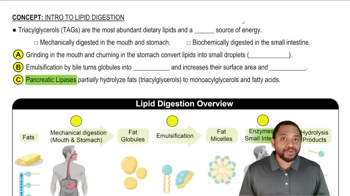
What are triacylglycerols (TAGs) and why are they important in the diet?
TAGs are the most abundant dietary lipids and serve as a rich source of energy.
Where does mechanical digestion of TAGs occur in the digestive system?
Mechanical digestion of TAGs occurs in the mouth and stomach.
What is the result of mechanical digestion of lipids in the mouth and stomach?
Mechanical digestion transforms lipids into small droplets called globules.
Where does biochemical digestion of TAGs primarily take place?
Biochemical digestion of TAGs mainly occurs in the small intestine.
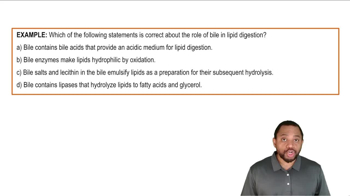
What role does bile play in lipid digestion?
Bile contains bile salts and emulsifying agents that convert fat globules into micelles.
What is emulsification in the context of lipid digestion?
Emulsification is the process where bile salts help transform fat globules into micelles.
How does emulsification affect the surface area and solubility of lipids?
Emulsification increases the surface area and solubility of lipids.
What are micelles and how are they formed during lipid digestion?
Micelles are small, soluble fat droplets formed from globules by the action of bile.
What components in bile are responsible for emulsifying fat globules?
Bile contains phospholipids and bile salts that emulsify fat globules.
What enzyme is responsible for hydrolyzing TAGs in the small intestine?
Pancreatic lipases hydrolyze TAGs in the small intestine.
What are the products of TAG hydrolysis by pancreatic lipases?
TAG hydrolysis produces monoacylglycerol and fatty acids.
What chemical bonds are broken during TAG hydrolysis?
Ester linkages within TAGs are severed during hydrolysis.
How many Acetyl CoA molecules can be produced from TAGs compared to glucose?
TAGs can produce many Acetyl CoA molecules, while glucose produces only two.
What is the sequence of events in lipid digestion from mouth to intestine?
Lipids are mechanically digested into globules, emulsified into micelles, and then hydrolyzed by lipases.
Why is emulsification necessary for efficient lipid digestion?
Emulsification increases lipid surface area, making them more accessible to digestive enzymes.
 IndietroIndietro
 1:34
1:34