Skip to main content
GOB Chemistry
Il mio corso
Impara
Preparazione agli esami
AI Tutor
Guide di studio
Soluzioni per libri di testo
Flashcard
Esplora
Prova l'app
Il mio corso
Impara
Preparazione agli esami
AI Tutor
Guide di studio
Soluzioni per libri di testo
Flashcard
Esplora
Prova l'app
Indietro
Intro to Redox Reactions quiz
Puoi toccare per girare la carta.
What is the general chemistry definition of a redox reaction?
Puoi toccare per girare la carta.
👆
What is the general chemistry definition of a redox reaction?
A redox reaction involves the transfer of electrons between reactants.
Avanzamenti del tracciato
I pulsanti di controllo sono stati cambiati in modalità "navigazione".
1/15
Flashcard correlate
Pratica correlata
Video consigliati
Intro to Redox Reactions definitions
Intro to Redox Reactions
13 Termini
Intro to Redox Reactions
14. Compounds with Oxygen or Sulfur
3 Problemi
Argomento
Ernest
Alcohol Reactions: Oxidation Reactions
14. Compounds with Oxygen or Sulfur
5 Problemi
Argomento
Jules
14. Compounds with Oxygen or Sulfur
7 Argomenti
15 Problemi
Capitolo
Jules
VideoThumbView.guidedCourse
3:12
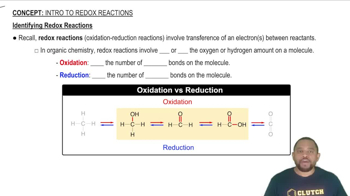
Identifying Redox Reactions Concept 1
1474
views
6
rank
VideoThumbView.guidedCourse
1:19
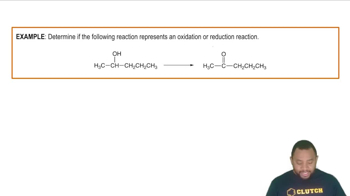
Intro To Redox Reactions Example 1
1364
views
4
rank
Termini in questo insieme (15)
Nascondere definizioni
What is the general chemistry definition of a redox reaction?
A redox reaction involves the transfer of electrons between reactants.
How are redox reactions defined in organic chemistry?
Redox reactions in organic chemistry involve increasing or decreasing the number of oxygen or hydrogen atoms bonded to carbon in a molecule.
What characterizes oxidation in organic chemistry?
Oxidation is characterized by an increase in the number of carbon-oxygen bonds in a molecule.
What characterizes reduction in organic chemistry?
Reduction involves an increase in the number of carbon-hydrogen bonds in a molecule.
Which types of compounds are typically excluded from organic redox discussions?
Hydrocarbons and carbon dioxide are usually excluded from organic redox discussions.
What is the first oxidation step for a hydrocarbon?
The first oxidation step forms the first carbon-oxygen bond, converting a hydrocarbon to an alcohol.
What happens to the number of carbon-oxygen bonds when an alcohol is oxidized to an aldehyde or ketone?
The number of carbon-oxygen bonds increases from one to two.
What is formed when an aldehyde or ketone is further oxidized?
Further oxidation forms a carboxylic acid, which has three carbon-oxygen bonds.
What is the focus of organic redox reactions in terms of compound types?
The focus is on transformations between alcohols, aldehydes/ketones, and carboxylic acids.
What is the first reduction step starting from a carboxylic acid?
The first reduction step decreases the number of carbon-oxygen bonds from three to two, forming an aldehyde or ketone.
What happens to carbon-hydrogen bonds during reduction from aldehyde/ketone to alcohol?
The number of carbon-hydrogen bonds increases as the molecule is reduced to an alcohol.
Why are hydrocarbons and carbon dioxide not the focus in organic redox reactions?
They are not considered organic molecules in the context of redox transformations between alcohols, aldehydes/ketones, and carboxylic acids.
What is the relationship between oxidation and carbon-oxygen bonds?
Oxidation increases the number of carbon-oxygen bonds in a molecule.
What is the relationship between reduction and carbon-hydrogen bonds?
Reduction increases the number of carbon-hydrogen bonds in a molecule.
Which section of the oxidation-reduction diagram is most relevant in organic chemistry?
The section between alcohols, aldehydes/ketones, and carboxylic acids is most relevant.
 IndietroIndietro

 3:12
3:12