Skip to main content
GOB Chemistry
Il mio corso
Impara
Preparazione agli esami
AI Tutor
Guide di studio
Soluzioni per libri di testo
Flashcard
Esplora
Prova l'app
Il mio corso
Impara
Preparazione agli esami
AI Tutor
Guide di studio
Soluzioni per libri di testo
Flashcard
Esplora
Prova l'app
Indietro
Lipoproteins for Transport quiz
Puoi toccare per girare la carta.
Why are lipoproteins necessary for transporting lipids in the blood?
Puoi toccare per girare la carta.
👆
Why are lipoproteins necessary for transporting lipids in the blood?
Lipoproteins are needed because lipids are nonpolar and insoluble in the aqueous environment of blood.
Avanzamenti del tracciato
I pulsanti di controllo sono stati cambiati in modalità "navigazione".
1/15
Flashcard correlate
Pratica correlata
Video consigliati
Lipoproteins for Transport definitions
Lipoproteins for Transport
14 Termini
Lipoproteins for Transport
24. Lipid Metabolism
5 Problemi
Argomento
Nicole
Glycerol Metabolism
24. Lipid Metabolism
4 Problemi
Argomento
Nicole
24. Lipid Metabolism - Part 1 of 2
8 Argomenti
15 Problemi
Capitolo
KeyshawnDavis
24. Lipid Metabolism - Part 2 of 2
1 Argomento
3 Problemi
Capitolo
Nicole
VideoThumbView.guidedCourse
1:39
Lipoproteins for Transport Concept 1
2297
views
1
rank
VideoThumbView.guidedCourse
1:27
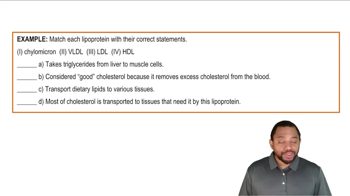
Lipoproteins for Transport Example 1
2292
views
3
rank
VideoThumbView.guidedCourse
3:52
Lipoproteins for Transport Concept 2
2174
views
Termini in questo insieme (15)
Nascondere definizioni
Why are lipoproteins necessary for transporting lipids in the blood?
Lipoproteins are needed because lipids are nonpolar and insoluble in the aqueous environment of blood.
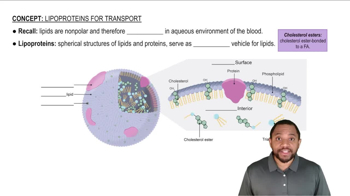
What are lipoproteins composed of?
Lipoproteins are spherical structures made of lipids and proteins.
What is a cholesterol ester?
A cholesterol ester is cholesterol bonded to a fatty acid.
Describe the structure of a chylomicron.
A chylomicron has a protein surface, a phospholipid bilayer, and a nonpolar interior containing cholesterol esters and triglycerides.
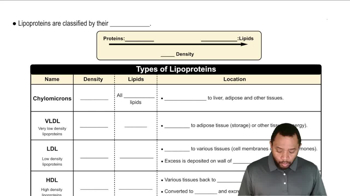
How are lipoproteins classified?
Lipoproteins are classified by their density, which depends on their protein to lipid ratio.
What happens to lipoprotein density as the protein content increases?
As protein content increases, lipoprotein density also increases because proteins are denser than lipids.
List the four main types of lipoproteins in order of increasing density.
The four types are chylomicrons (lowest), VLDL, LDL, and HDL (highest).
Which lipoprotein has the lowest density?
Chylomicrons have the lowest density among lipoproteins.
What type of lipids do chylomicrons transport?
Chylomicrons transport dietary lipids.
Where do chylomicrons transport lipids from and to?
Chylomicrons transport lipids from the intestines to the liver, adipose tissue, and other tissues.
What is the main function of VLDL?
VLDL transports triglycerides from the liver to adipose tissue for storage or other tissues for energy.
What does LDL primarily carry and where does it transport it?
LDL primarily carries cholesterol from the liver to various tissues.
Why is excess LDL considered harmful?
Excess LDL can deposit cholesterol in artery walls, increasing health risks.
What is the role of HDL in lipid transport?
HDL transports cholesterol from various tissues back to the liver, where it is converted to bile and excreted.
How does the protein to lipid ratio affect lipoprotein density?
A higher protein to lipid ratio results in greater lipoprotein density.
 IndietroIndietro
 1:39
1:39