Skip to main content
GOB Chemistry
Il mio corso
Impara
Preparazione agli esami
AI Tutor
Guide di studio
Soluzioni per libri di testo
Flashcard
Esplora
Prova l'app
Il mio corso
Impara
Preparazione agli esami
AI Tutor
Guide di studio
Soluzioni per libri di testo
Flashcard
Esplora
Prova l'app
Indietro
Physical Properties of Fatty Acids definitions
Puoi toccare per girare la carta.
Fatty Acids
Puoi toccare per girare la carta.
👆
Fatty Acids
Molecules composed of long hydrocarbon chains with a carboxylic acid group, exhibiting varying physical properties based on structure.
Avanzamenti del tracciato
I pulsanti di controllo sono stati cambiati in modalità "navigazione".
1/13
Flashcard correlate
Pratica correlata
Video consigliati
Physical Properties of Fatty Acids quiz
Physical Properties of Fatty Acids
15 Termini
Physical Properties of Fatty Acids
23. Lipids
5 Problemi
Argomento
Ernest
Waxes
23. Lipids
3 Problemi
Argomento
Ernest
23. Lipids - Part 1 of 3
6 Argomenti
13 Problemi
Capitolo
Ernest
23. Lipids - Part 2 of 3
6 Argomenti
12 Problemi
Capitolo
Nicole
23. Lipids - Part 3 of 3
1 Argomento
3 Problemi
Capitolo
VideoThumbView.guidedCourse
2:09
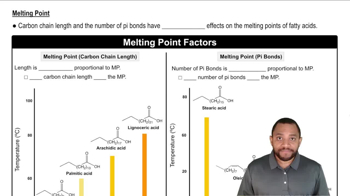
Physical Properties of Fatty Acids Concept 2
3006
views
4
rank
VideoThumbView.guidedCourse
1:54
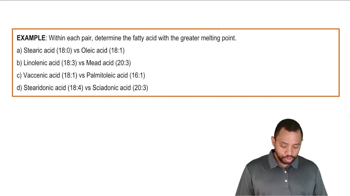
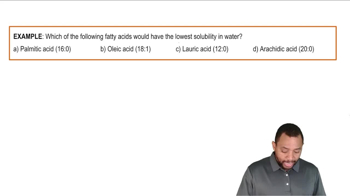
Physical Properties of Fatty Acids Example 2
2513
views
5
rank
VideoThumbView.guidedCourse
1:02
Physical Properties of Fatty Acids Example 1
2853
views
3
rank
Termini in questo insieme (13)
Nascondere definizioni
Fatty Acids
Molecules composed of long hydrocarbon chains with a carboxylic acid group, exhibiting varying physical properties based on structure.
Carbon Chain Length
Number of carbon atoms in a hydrocarbon tail, influencing both solubility in water and melting point.
Solubility
Ability to dissolve in water, which decreases as hydrocarbon chains become longer and more nonpolar.
Melting Point
Temperature at which a substance transitions from solid to liquid, rising with longer hydrocarbon chains.
Pi Bonds
Double bonds within hydrocarbon chains, which disrupt packing and lower the temperature needed for melting.
Nonpolarity
Characteristic of molecules with even electron distribution, leading to poor interaction with polar solvents like water.
Lauric Acid
A saturated fatty acid with a relatively short chain, resulting in a lower melting point compared to longer chains.
Palmitic Acid
A saturated fatty acid with a medium-long chain, exhibiting a higher melting point than shorter-chain counterparts.
Stearic Acid
A saturated fatty acid with a long chain, notable for a melting point exceeding 60°C.
Oleic Acid
A monounsaturated fatty acid with one double bond, causing a significant drop in melting point compared to saturated analogs.
Linoleic Acid
A polyunsaturated fatty acid with two double bonds, resulting in a melting point below 0°C.
Direct Proportionality
Relationship where an increase in one variable, such as chain length, leads to an increase in another, like melting point.
Inverse Proportionality
Relationship where an increase in one variable, such as pi bonds, leads to a decrease in another, like melting point.
 IndietroIndietro

 2:09
2:09