 Indietro
GOB Chemistry Chapter 1 Basics
 01:34
01:34
Termini in questo insieme (26)
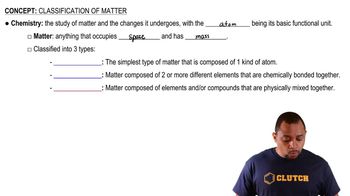
Matter is anything that takes up space and has weight.
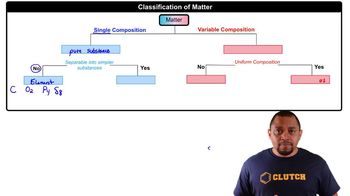
Pure substances and mixtures.
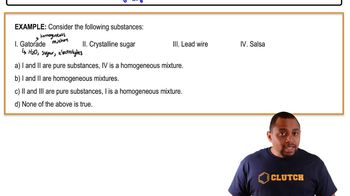
A pure substance contains only one type of substance and is represented by one chemical symbol or formula.
An element is made of one type of atom; a compound is two or more elements chemically joined.
A homogeneous mixture is uniform throughout and its parts cannot be easily seen.
A heterogeneous mixture is not uniform and different parts can usually be seen.
A group is a vertical column; elements in the same group have similar chemical behavior.
A period is a horizontal row, numbered 1 to 7.
Multiply atoms inside parentheses by the subscript outside: Mg = 1, N = 2, O = 6.
Physical change: form changes but identity stays the same.
Chemical change: new substance forms, identity changes.
The arrow means reacts to form, showing reactants on the left and products on the right.
Adjust coefficients to have equal atoms on both sides; do not change subscripts.
Round the answer to the fewest decimal places in the numbers used.
Round the answer to the fewest significant figures in the numbers used.
Expressing numbers as \(C \times 10^{n}\) where 1 ≤ C < 10 and n is an integer.
Mass = kilogram (kg), Volume = liter (L), Length = meter (m).
\(d = \frac{m}{V}\) where d = density, m = mass, V = volume.
Specific gravity = density of sample ÷ density of water; it has no units.
\(K = ^\circ C + 273\)
\(^\circ C = \frac{(^\circ F - 32)}{1.8}\)
Heat needed to raise 1 g of a substance by 1°C; \(SH = \frac{heat}{mass \times \Delta T}\).
Solid: definite shape and volume.
Liquid: definite volume, shape of container.
Gas: no definite shape or volume, fills container.
Accuracy: closeness to true value.
Precision: closeness of repeated measurements.
\(\% = \frac{part}{whole} \times 100\)
Energy unit: joule (J).
1 calorie = 4.184 J, 1 Calorie = 1000 calories.
1. Addition/subtraction → decimal places.
2. Multiplication/division → significant figures.
3. Density = mass ÷ volume.
4. Set conversions so unwanted units cancel.
5. Do not round until the end of multi-step problems.