 Indietro
GOB Chemistry: Chemical Equations and Examples
 04:21
04:21
Termini in questo insieme (20)
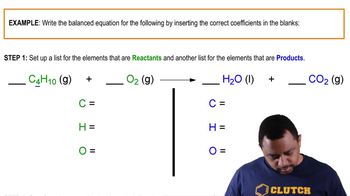
A chemical equation represents a chemical reaction using symbols and formulas of the reactants and products.
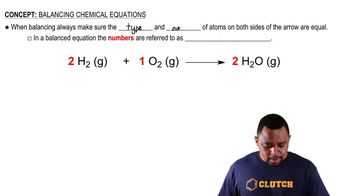
Adjust the coefficients of reactants and products to have the same number of each atom on both sides, obeying the law of conservation of mass.
Balanced form: \(2\mathrm{H_2 + O_2 \rightarrow 2H_2O}\)
The coefficient indicates the number of molecules or moles of a substance involved in the reaction.
Balanced equation: \(\mathrm{N_2 + 3H_2 \rightarrow 2NH_3}\)
Write the correct formulas for all reactants and products before adjusting coefficients.
Balanced equation: \(\mathrm{C_3H_8 + 5O_2 \rightarrow 3CO_2 + 4H_2O}\)
To satisfy the law of conservation of mass, ensuring atoms are neither created nor destroyed.
Balanced equation: \(4Fe + 3O_2 \rightarrow 2Fe_2O_3\)
A reactant is a substance that undergoes change during a chemical reaction, shown on the left side of the equation.
A product is a substance formed as a result of a chemical reaction, shown on the right side of the equation.
Balanced equation: \(4Al + 3O_2 \rightarrow 2Al_2O_3\)
Count the number of atoms of each element on both sides; they must be equal.
Balanced equation: \(2Na + Cl_2 \rightarrow 2NaCl\)
The arrow (→) indicates the direction of the reaction, from reactants to products.
Balanced equation: \(Mg + 2HCl \rightarrow MgCl_2 + H_2\)
Subscripts show the number of atoms of each element in a molecule and cannot be changed when balancing.
Balanced equation: \(2KClO_3 \rightarrow 2KCl + 3O_2\)
A coefficient is a number placed before a formula to indicate how many molecules or moles participate.
Balanced equation: \(H_2SO_4 + 2NaOH \rightarrow Na_2SO_4 + 2H_2O\)