Skip to main content
GOB Chemistry
Il mio corso
Impara
Preparazione agli esami
AI Tutor
Guide di studio
Soluzioni per libri di testo
Flashcard
Esplora
Prova l'app
Il mio corso
Impara
Preparazione agli esami
AI Tutor
Guide di studio
Soluzioni per libri di testo
Flashcard
Esplora
Prova l'app
Indietro
GOB Chemistry: Chemical Quantities and Reactions
Puoi toccare per girare la carta.
What is Avogadro's number and what does it represent?
Puoi toccare per girare la carta.
👆
What is Avogadro's number and what does it represent?
Avogadro's number
is \(6.02 \times 10^{23}\) and it represents the number of particles (atoms, molecules, or ions) in one mole of a substance.
Avanzamenti del tracciato
I pulsanti di controllo sono stati cambiati in modalità "navigazione".
1/20
Video consigliati
VideoThumbView.guidedCourse
02:41
Mole Concept
11752
views
104
rank
VideoThumbView.guidedCourse
01:41
Mole Concept Example 3
10844
views
70
rank
VideoThumbView.guidedCourse
01:28
Mole Concept Example 1
12081
views
93
rank
Termini in questo insieme (20)
Nascondere definizioni
What is Avogadro's number and what does it represent?
Avogadro's number
is \(6.02 \times 10^{23}\) and it represents the number of particles (atoms, molecules, or ions) in one mole of a substance.
How many atoms are in 1 mole of carbon?
1 mole of carbon contains \(6.02 \times 10^{23}\) atoms of carbon.
What is the molar mass of an element?
The
molar mass
is the mass in grams of 1 mole of an element, numerically equal to the atomic mass but expressed in grams.
How do you calculate the molar mass of a compound like Li2CO3?
Multiply the molar mass of each element by its subscript in the formula and sum the results: 2 Li, 1 C, and 3 O atoms.
What is the relationship between grams and moles for a substance?
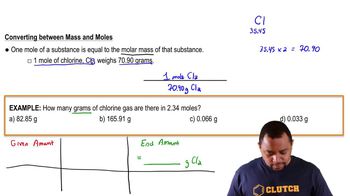
Molar mass acts as a conversion factor between grams and moles: \(\frac{grams}{mole}\).
How do you convert moles of a compound to moles of an element within it?
Use the subscript of the element in the chemical formula as a conversion factor (e.g., 9 moles of C per 1 mole of C9H8O4).
What is a balanced chemical equation?
An equation where the number of atoms of each element is equal on both reactant and product sides, with no atoms lost or gained.
What are the steps to balance a chemical equation?
Write correct formulas, count atoms, use coefficients to balance elements, and verify the final balanced equation.
What is oxidation in a chemical reaction?
Oxidation
is the loss of electrons by a substance.
What is reduction in a chemical reaction?
Reduction
is the gain of electrons by a substance.
What is the mnemonic to remember oxidation and reduction?
OIL RIG
: Oxidation Is Loss, Reduction Is Gain of electrons.
In the reaction Zn(s) + CuSO4(aq) → ZnSO4(aq) + Cu(s), which is oxidized and which is reduced?
Zn is oxidized (loses electrons), Cu2+ is reduced (gains electrons).
What is an oxidizing agent?
The substance that gains electrons and causes another to be oxidized.
What is a reducing agent?
The substance that loses electrons and causes another to be reduced.
What is an exothermic reaction?
A reaction that releases heat, with products having less energy than reactants.
What is an endothermic reaction?
A reaction that absorbs heat, with products having more energy than reactants.
What are the three conditions required for a chemical reaction to occur?
1. Reactants must collide, 2. Proper orientation, 3. Sufficient activation energy.
How does temperature affect reaction rate?
Increasing temperature increases reaction rate by causing more frequent and energetic collisions.
What is the role of a catalyst in a chemical reaction?
A catalyst increases the reaction rate by lowering the activation energy without being consumed.
How does concentration affect the rate of reaction?
Increasing the concentration of reactants increases the reaction rate by increasing collision frequency.
 IndietroIndietro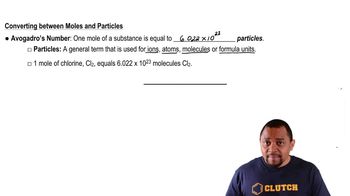
 02:41
02:41