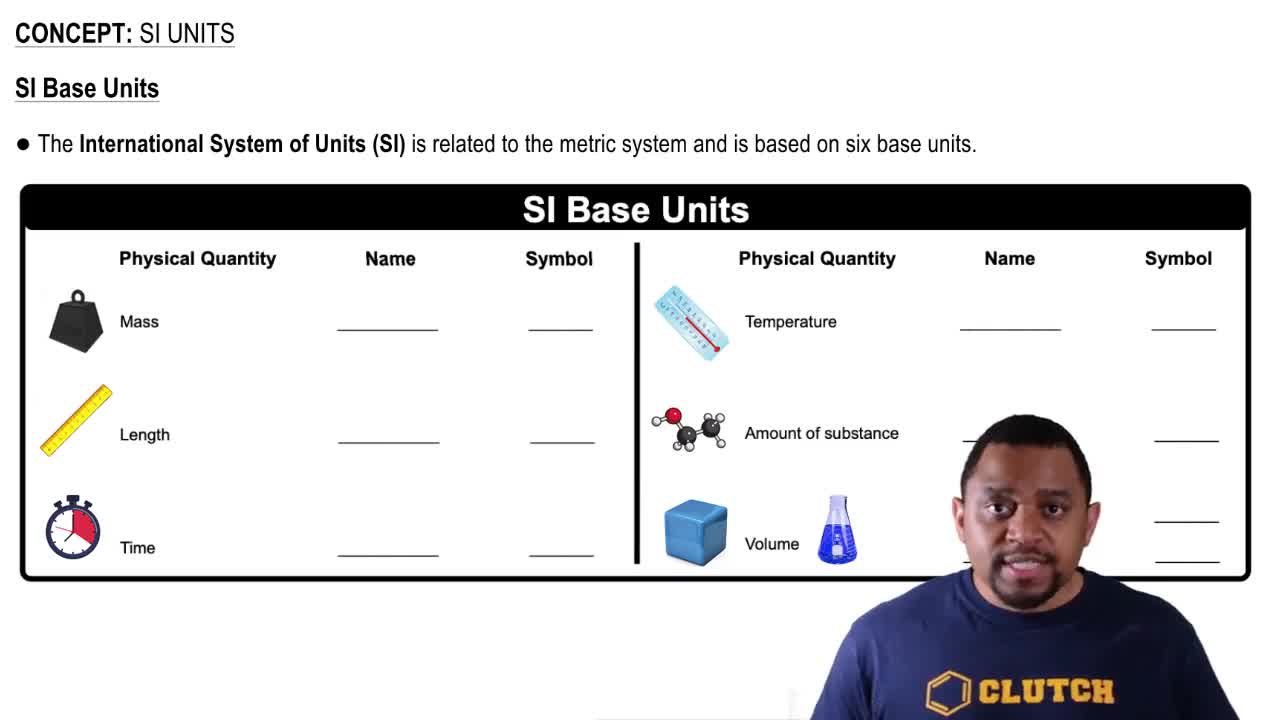
Use appropriate conversion factors based on unit relationships to multiply or divide quantities, ensuring units cancel correctly.
How do you determine the number of significant figures in a number?
Count all certain digits plus one estimated digit, ignoring leading zeros but counting zeros between or after digits if they are significant.
How is scientific notation correctly written?
Express a number as a product of a number between 1 and 10 and a power of 10, e.g., 3.2 × 10\(^5\).
How do you use conversion factors to solve dosage and percentage problems?
Set up ratios from known equivalences to convert units or calculate percentages by relating parts to whole.
How do you calculate density?
Density = mass ÷ volume; given any two, calculate the third using this formula.
What is specific gravity and how is it used?
Specific gravity is the ratio of a substance's density to the density of water; used to compare densities without units.
How is matter classified?
Matter is classified as elements, compounds, or mixtures based on composition and properties.
What are the properties of solids, liquids, and gases?
Solids have fixed shape and volume; liquids have fixed volume but no fixed shape; gases have neither fixed shape nor volume.
What distinguishes chemical changes from physical changes?
Chemical changes alter composition and produce new substances; physical changes affect form or state without changing composition.
How do you convert between Celsius, Fahrenheit, and Kelvin?
Use formulas: °C = (°F - 32) × 5/9; K = °C + 273.15; °F = °C × 9/5 + 32.
Compare kinetic energy and potential energy.
Kinetic energy is energy of motion; potential energy is stored energy based on position or configuration.
What is a heating and cooling curve?
A graph showing temperature changes of a substance as it absorbs or releases heat during phase changes.
Define specific heat and its use in calculations.
Specific heat is the heat required to raise 1 gram of a substance by 1°C; used to calculate heat transfer with q = m × c × ΔT.
What are the phase changes between solid, liquid, and gas?
Melting, freezing, vaporization, condensation, sublimation, and deposition are phase changes between states.
How to calculate heat absorbed or released during phase changes?
Use q = m × ΔH, where ΔH is the enthalpy of fusion or vaporization depending on the phase change.
What is the structure of the periodic table?
Elements arranged by increasing atomic number in rows (periods) and columns (groups) showing periodic properties.
Describe the structure of an atom.
An atom has a nucleus with protons and neutrons, surrounded by electrons in energy levels.
What is an atomic mass unit (amu)?
A unit to express atomic and molecular masses, defined as one twelfth the mass of a carbon-12 atom.
Define atomic number, mass number, atomic symbol, and isotope.
Atomic number = protons; mass number = protons + neutrons; atomic symbol = element abbreviation; isotopes differ in neutron number.
Which elements are essential for human health?
Elements like C, H, O, N, Ca, P, K, S, Na, Cl, Mg, Fe, and others are essential for biological functions.
What are electron energy levels and sublevels (n, s, p, d, f)?
Energy levels (n) contain sublevels: s (1 orbital), p (3 orbitals), d (5 orbitals), f (7 orbitals), where electrons reside.
How to write electron configurations for the first 20 elements?
Fill orbitals in order: 1s, 2s, 2p, 3s, 3p, 4s, following the Aufbau principle and Pauli exclusion.
What are the s, p, d, f blocks in the periodic table?
Blocks correspond to the highest energy sublevel being filled: s-block (groups 1-2), p-block (13-18), d-block (3-12), f-block (lanthanides/actinides).
How to count valence electrons for the first 20 elements?
Valence electrons equal the group number for main-group elements; count electrons in outermost s and p orbitals.
How to predict atomic size, ionization energy, and metallic character?
Atomic size decreases across a period and increases down a group; ionization energy increases across a period and decreases down a group; metallic character is opposite of ionization energy trends.
 Indietro
 00:42
00:42