 Indietro
GOB Chemistry Exam I Review
 1:58
1:58
Termini in questo insieme (15)
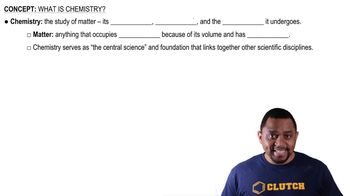
Chemistry is the study of matter, its properties, how and why substances combine or separate, and how substances interact with energy.
Matter is anything that has mass and occupies space.
Chemicals are substances with a defined composition and distinct properties, which make up matter.
Observation, hypothesis formation, experimentation, analysis, and conclusion.
Metals are on the left and center, nonmetals on the right, and metalloids lie along the zigzag line between metals and nonmetals.
Protons, neutrons, and electrons.
Photon is not a subatomic particle; it is a particle of light.
The nucleus contains protons and neutrons.
Neutron has no charge.
Atomic number = number of protons; mass number = protons + neutrons; isotopes are atoms of the same element with different numbers of neutrons.
Manganese has atomic number 25, so neutrons = 55 - 25 = 30 neutrons.
Ionic bonds form by transfer of electrons between metals and nonmetals; covalent bonds form by sharing electrons between nonmetals.
A charged ion composed of two or more atoms covalently bonded.
By sharing electrons between two or more nonmetal atoms (covalent bonding).
D is false; when metal loses electrons, a positive ion (cation) is formed.