 Indietro
GOB Chemistry Key Concepts
 01:34
01:34
Termini in questo insieme (30)
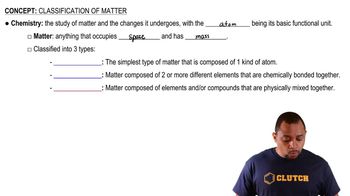
Matter is anything that has mass and occupies space.
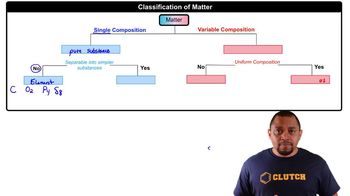
Pure substances have a fixed composition; mixtures contain two or more substances physically combined.
An element is a pure substance made of only one type of atom.
An atom is the smallest unit of an element that retains its chemical properties.
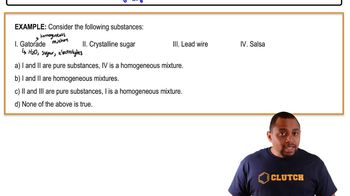
Homogeneous mixtures have uniform composition; heterogeneous mixtures have visibly different parts.
Groups are vertical columns with similar properties; periods are horizontal rows indicating energy levels.
Metals are mostly on the left and center; halogens are in group 7A; noble gases in group 8A; nonmetals are on the right side.
Atomic number is the number of protons; atomic mass is the weighted average mass of isotopes.
Physical changes alter form without changing composition; chemical changes produce new substances.
Reactants are substances before reaction; products are substances formed after reaction.
Adjust coefficients to have equal numbers of each atom on both sides, ensuring mass conservation.
Significant figures indicate the precision of a measurement, including all known digits plus one estimated digit.
A way to express very large or small numbers as \(a \times 10^{n}\), where a is between 1 and 10.
Density is mass per unit volume, calculated as \(\frac{mass}{volume}\).
Electrons are negatively charged, orbit nucleus; protons are positive in nucleus; neutrons are neutral in nucleus.
Isotopes are atoms of the same element with different numbers of neutrons.
Radioactive decay is the spontaneous breakdown of a nucleus; half-life is the time for half the nuclei to decay.
Each energy level n can hold up to \(2n^{2}\) electrons.
Valence electrons are the outermost electrons involved in bonding.
Atoms tend to gain, lose, or share electrons to have eight valence electrons like noble gases.
Cations are positively charged ions; anions are negatively charged ions.
Ionic compounds form from electrostatic attraction between cations and anions.
Use the charge of one ion as the subscript of the other to write neutral ionic formulas.
Name the cation first, then the anion with an '-ide' suffix or polyatomic ion name.
Covalent bonds involve sharing electrons between atoms to form molecules.
Polar bonds have unequal electron sharing due to electronegativity differences; nonpolar bonds share electrons equally.
Diagrams showing valence electrons as dots around atomic symbols to represent bonding and lone pairs.
VSEPR predicts molecular geometry based on electron pair repulsions around the central atom.
Electronegativity increases across a period and decreases down a group on the periodic table.
Molar mass is the mass of one mole of a substance; used to convert between mass, moles, and number of particles.