 Indietro
GOB Chemistry: Matter, Measurements, Atoms, and Periodic Table
 01:34
01:34
Termini in questo insieme (20)
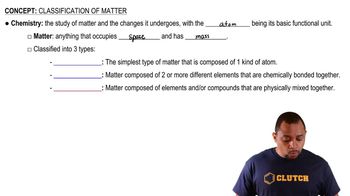
Matter is anything that has mass and occupies space.
Solid, liquid, and gas.
The gram (g) is the basic unit of mass.
The meter (m) is the SI unit for length.
An atom is the smallest unit of an element that retains its chemical properties.
Protons, neutrons, and electrons.
In the nucleus at the center of the atom.
In the electron cloud surrounding the nucleus.
The number of protons in an atom's nucleus.
The total number of protons and neutrons in the nucleus.
Atoms of the same element with different numbers of neutrons.
A chart that organizes elements by increasing atomic number and similar chemical properties.
By increasing atomic number in rows called periods and columns called groups or families.
They have similar chemical properties and the same number of valence electrons.
A quantitative observation that includes a number and a unit.
Units provide the scale and context for the numerical value.
Accuracy is how close a measurement is to the true value; precision is how reproducible measurements are.
They indicate the certainty of a measurement and affect calculation results.
Matter cannot be created or destroyed in a chemical reaction, only transformed.
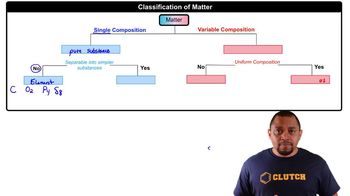
An element contains only one type of atom; a compound contains two or more elements chemically combined.