Skip to main content
GOB Chemistry
Il mio corso
Impara
Preparazione agli esami
AI Tutor
Guide di studio
Soluzioni per libri di testo
Flashcard
Esplora
Prova l'app
Il mio corso
Impara
Preparazione agli esami
AI Tutor
Guide di studio
Soluzioni per libri di testo
Flashcard
Esplora
Prova l'app
Indietro
GOB Chemistry: Units, Laws, and Scientific Notation
Puoi toccare per girare la carta.
What is the relationship between a decigram and a gram?
Puoi toccare per girare la carta.
👆
What is the relationship between a decigram and a gram?
1 decigram (dg) = 0.1 gram (g)
, meaning a decigram is smaller than a gram by a factor of 10.
Avanzamenti del tracciato
I pulsanti di controllo sono stati cambiati in modalità "navigazione".
1/20
Video consigliati
VideoThumbView.guidedCourse
03:59
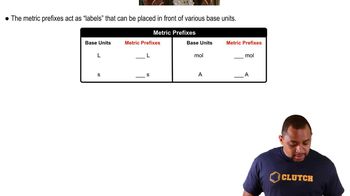
Metric Prefixes
18539
views
297
rank
1
comments
VideoThumbView.guidedCourse
01:16
Metric Prefixes
13274
views
187
rank
VideoThumbView.guidedCourse
03:37
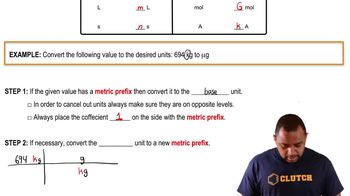
Metric Prefixes Example 1
12951
views
199
rank
1
comments
Termini in questo insieme (20)
Nascondere definizioni
What is the relationship between a decigram and a gram?
1 decigram (dg) = 0.1 gram (g)
, meaning a decigram is smaller than a gram by a factor of 10.
How many centigrams are in one gram?
100 centigrams (cg) = 1 gram (g)
. Centigrams are smaller units than grams by a factor of 100.
What does the prefix 'milli' represent in terms of grams?
1 milligram (mg) = 0.001 gram (g)
. Milli means one thousandth of the base unit.
What is the size relationship of a kilogram to a gram?
1 kilogram (kg) = 1000 grams (g)
. Kilogram is 1000 times larger than the base unit gram.
List the metric prefixes from larger to smaller around the base unit gram.
Kilo (1000x), base unit gram (1x), deci (0.1x), centi (0.01x), milli (0.001x), micro (1.0×10⁻⁶), nano (1.0×10⁻⁹)
.
What is the purpose of scientific notation?
To make very large or very small numbers easier to work with by expressing them as a coefficient times 10 raised to an exponent.
How do you identify a positive versus a negative exponent in scientific notation?
Positive exponent
means the number is larger than one;
negative exponent
means the number is smaller than one.
What is the general form of scientific notation?
A number expressed as \(a \times 10^{n}\) where
a
is between 1 and 10, and
n
is an integer exponent.
How do you convert 3970 into scientific notation?
Move the decimal 3 places left: \(3.97 \times 10^{3}\).
What is Boyle's Law formula and what does it describe?
Boyle's Law:
\(P_i V_i = P_f V_f\). It describes the inverse relationship between pressure and volume at constant temperature.
What is Charles's Law formula and what does it describe?
Charles's Law:
\(\frac{V_i}{T_i} = \frac{V_f}{T_f}\). It describes the direct relationship between volume and temperature at constant pressure.
What are the customary and metric units for mass?
Customary:
pounds (lbs);
Metric:
grams (g).
What are the customary and metric units for volume?
Customary:
fluid ounces (fl. oz);
Metric:
liters (L).
What are the customary and metric units for length?
Customary:
inches (in);
Metric:
meters (m).
How do you convert 1 kilogram to pounds?
1 kilogram = 2.205 pounds (lbs)
.
How many milliliters are in 1 teaspoon?
1 teaspoon (tsp) = 5.0 milliliters (mL)
.
What is the equivalence between milliliters and cubic centimeters?
1 milliliter (mL) = 1 cubic centimeter (cc)
.
How many kilometers are in 1 mile?
1 mile (mi) = 1.609 kilometers (km)
.
What is the meaning of the coefficient in scientific notation?
The coefficient is the first part of the number, greater than or equal to 1 but less than 10.
What does the exponent in scientific notation represent?
The exponent shows how many times the decimal point was moved to convert the number into scientific notation.
 IndietroIndietro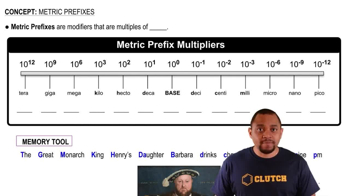
 03:59
03:59