 Indietro
LECTURE ONE - MASTER STUDY FLASHCARDS
 02:53
02:53
Termini in questo insieme (20)
Matter is the physical material of the universe; anything that has mass and occupies space (volume).
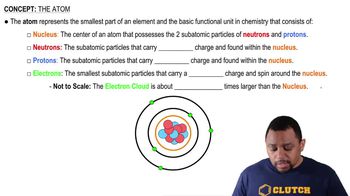
Atom: Smallest particle of matter (element).
Element: Pure substance with one kind of atom.
Molecule: Smallest unit of pure substance retaining properties, made of atoms.
Compound: Pure substance with multiple kinds of atoms.
Carbon (C), Nitrogen (N), Oxygen (O), and Hydrogen (H) are the most prevalent elements in the human body.
The atomic number is the number of protons in an element, represented as \(Z\).
Isotopes are atoms with the same number of protons (atomic number) but different numbers of neutrons.
Mass number (\(A\)) = number of protons + number of neutrons.
A neutral atom has equal numbers of protons and electrons, resulting in no net charge.
Elements are organized by increasing atomic number and grouped by similar chemical properties in columns called groups or families.
Periods are horizontal rows representing electron shells (principal quantum number n).
Groups are vertical columns representing valence electron subshells.
Valence electrons are electrons in the outermost shell of an atom that determine chemical properties and bonding.
The octet rule states atoms are most stable when they have 8 valence electrons in their outer shell.
Ionic bonds form by transfer of electrons between atoms.
Covalent bonds form by sharing electrons between atoms.
Ion: Atom with unequal protons and electrons.
Cation: Positively charged ion (more protons).
Anion: Negatively charged ion (more electrons).
Ionic bonds form by electrostatic attraction between oppositely charged ions (cations and anions).
The Lewis symbol uses dots to represent the number of valence electrons around an element's symbol.
Ionization energy is the energy required to remove an electron from an atom.
Electronegativity measures how strongly an atom attracts electrons in a bond.
Atomic size and metallic character increase down groups and decrease across periods from left to right.
Common polyatomic ions include ammonium (NH4+), hydronium (H3O+), hydroxide (OH-), bicarbonate (HCO3-), carbonate (CO32-), sulfate (SO42-), phosphate (PO43-), and cyanide (CN-).
Molecular weight is the sum of the atomic weights of all atoms in a molecule.