Ch.10 Proteins Workers of the Cell
Frost - General, Organic and Biological Chemistry 4th Edition
Frost4th EditionGeneral, Organic and Biological ChemistryISBN: 9780134988696Non è quello che usi tu?Cambia libro di testo
Capitolo 6, Problema 88

The enzyme sucrase catalyzes the hydrolysis of the disaccharide sucrose but not the disaccharide lactose. Does the induced-fit or lock-and-key model explain the action of sucrase better? Explain.

Guida verificata passo dopo passo
1
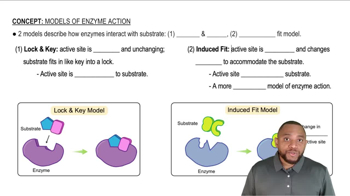
Understand the two models of enzyme action: The lock-and-key model suggests that the enzyme's active site is a perfect fit for the substrate, like a key fitting into a lock. The induced-fit model proposes that the enzyme's active site undergoes a conformational change to better fit the substrate upon binding.
Identify the specificity of sucrase: Sucrase catalyzes the hydrolysis of sucrose but does not act on lactose. This indicates that sucrase has a high specificity for its substrate, sucrose.
Analyze the lock-and-key model: According to this model, sucrase's active site would be a perfect match for sucrose, but it would not fit lactose due to differences in molecular structure.
Analyze the induced-fit model: This model suggests that sucrase's active site adjusts its shape to accommodate sucrose, but it cannot adjust sufficiently to bind lactose due to structural incompatibility.
Conclude which model fits better: The induced-fit model better explains the action of sucrase because it accounts for the enzyme's ability to adapt to the substrate's shape while maintaining specificity, which aligns with sucrase's selective action on sucrose and not lactose.

Risposta video verificata per un problema simile:

Questa soluzione video è stata consigliata dai nostri tutor come utile per risolvere questo problema.
Durata del video:
3m

Concetti chiave

Ecco i concetti essenziali che devi comprendere per rispondere correttamente alla domanda.

Induced-Fit Model

The induced-fit model of enzyme action suggests that the enzyme's active site is flexible and can change shape to better fit the substrate upon binding. This model emphasizes the dynamic nature of enzyme-substrate interactions, allowing for a more precise fit that enhances catalytic efficiency. In the case of sucrase, this model may explain how the enzyme adapts to the specific structure of sucrose, facilitating its hydrolysis.
Video consigliato:
Percorso guidato
2:39
Models of Enzyme Action Concept 1

Lock-and-Key Model

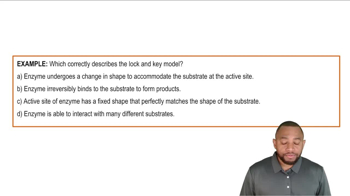
The lock-and-key model posits that enzymes and substrates fit together in a rigid, complementary manner, much like a key fits into a lock. This model implies that the active site of the enzyme is specifically shaped to match the substrate, allowing for a straightforward interaction. While this model provides a clear visualization of enzyme specificity, it may not fully account for the flexibility observed in enzyme-substrate interactions, particularly for sucrase.
Video consigliato:
Percorso guidato
1:26
Models of Enzyme Action Example 1

Enzyme Specificity

Enzyme specificity refers to the ability of an enzyme to selectively catalyze a particular reaction for a specific substrate. This property is crucial for biological processes, as it ensures that enzymes only act on their intended substrates, preventing unwanted reactions. In the context of sucrase, its specificity for sucrose over lactose highlights the importance of structural compatibility and the underlying mechanisms that dictate enzyme function.
Video consigliato:
Percorso guidato
01:37
Specific Gravity