

Ch.10 Proteins Workers of the Cell
Frost - General, Organic and Biological Chemistry 4th Edition
Frost4th EditionGeneral, Organic and Biological ChemistryISBN: 9780134988696Non è quello che usi tu?Cambia libro di testo
Capitolo 6, Problema 30b

Myoglobin is a protein containing 153 amino acids. Approximately half of the amino acids in myoglobin have polar side chains.
b. Where would you expect the nonpolar side chains to be?

Guida verificata passo dopo passo
1
Understand the structure of proteins: Proteins like myoglobin have a complex three-dimensional structure that is crucial for their function. This structure is determined by the sequence of amino acids and their interactions.
Recognize the nature of side chains: Amino acids have side chains that can be polar or nonpolar. Polar side chains are hydrophilic (water-attracting), while nonpolar side chains are hydrophobic (water-repelling).
Consider the environment of myoglobin: Myoglobin is a globular protein that functions in an aqueous environment, such as the cytoplasm of cells.
Apply the principle of hydrophobic interactions: In aqueous environments, nonpolar side chains tend to cluster together away from water, often found in the interior of the protein structure.
Conclude the location of nonpolar side chains: Based on the above principles, you would expect the nonpolar side chains of myoglobin to be located in the interior of the protein, away from the aqueous environment.

Risposta video verificata per un problema simile:

Questa soluzione video è stata consigliata dai nostri tutor come utile per risolvere questo problema.
Durata del video:
4m

Concetti chiave

Ecco i concetti essenziali che devi comprendere per rispondere correttamente alla domanda.

Protein Structure

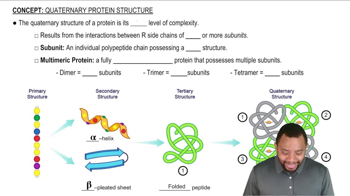
Proteins are composed of long chains of amino acids that fold into specific three-dimensional shapes. The structure of a protein is crucial for its function, and it is typically organized into four levels: primary, secondary, tertiary, and quaternary. Understanding how these structures relate to the properties of amino acids, such as polarity, is essential for predicting the behavior of proteins in different environments.
Video consigliato:
Percorso guidato
3:26
Quaternary Protein Structure Concept 1

Polarity of Amino Acids

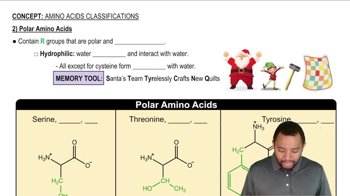
Amino acids can be classified based on the properties of their side chains, particularly their polarity. Polar amino acids have side chains that can form hydrogen bonds with water, making them hydrophilic, while nonpolar amino acids have hydrophobic side chains that do not interact favorably with water. This distinction influences how proteins fold and where different types of amino acids are located within the protein structure.
Video consigliato:
Percorso guidato
2:55
Polar Amino Acids Concept 2

Hydrophobic Effect

The hydrophobic effect is a key driving force in protein folding, where nonpolar side chains tend to aggregate away from the aqueous environment to minimize their exposure to water. This phenomenon leads to the clustering of nonpolar amino acids in the interior of the protein, while polar amino acids are often found on the surface, interacting with the surrounding water. Understanding this effect is crucial for predicting the spatial arrangement of amino acids in proteins like myoglobin.
Video consigliato:
Percorso guidato
04:38
Solubility: Temperature Effect Concept 1