Ch.10 Proteins Workers of the Cell
Frost - General, Organic and Biological Chemistry 4th Edition
Frost4th EditionGeneral, Organic and Biological ChemistryISBN: 9780134988696Non è quello che usi tu?Cambia libro di testo
Capitolo 6, Problema 26b

What type of interaction would you expect between the side chains of each of the following pairs of amino acids in the tertiary structure of a protein?
b. alanine and valine

Guida verificata passo dopo passo
1
Identify the side chains of alanine and valine. Alanine has a methyl group (-CH3) as its side chain, while valine has an isopropyl group (-CH(CH3)2) as its side chain.
Recognize that both alanine and valine have nonpolar, hydrophobic side chains.
Understand that in the tertiary structure of a protein, nonpolar side chains tend to interact with each other through hydrophobic interactions.
Explain that these hydrophobic interactions help stabilize the protein structure by minimizing the exposure of nonpolar side chains to the aqueous environment.
Conclude that the interaction between the side chains of alanine and valine in the tertiary structure of a protein is primarily hydrophobic.

Risposta video verificata per un problema simile:

Questa soluzione video è stata consigliata dai nostri tutor come utile per risolvere questo problema.
Durata del video:
3m

Concetti chiave

Ecco i concetti essenziali che devi comprendere per rispondere correttamente alla domanda.

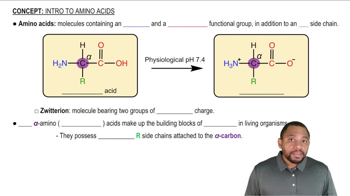
Amino Acid Side Chains

Amino acids have unique side chains (R groups) that determine their chemical properties and interactions. The side chains can be polar, nonpolar, acidic, or basic, influencing how they interact with each other in a protein's tertiary structure. Understanding these properties is crucial for predicting interactions between specific amino acids.
Video consigliato:
Percorso guidato
3:04
Intro to Amino Acids Concept 1

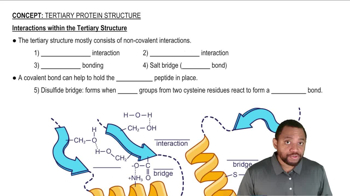
Hydrophobic Interactions

Hydrophobic interactions occur when nonpolar side chains, such as those of alanine and valine, cluster together to avoid contact with water. This phenomenon is a key driving force in protein folding, as it helps stabilize the protein's three-dimensional structure by minimizing the exposure of hydrophobic regions to the aqueous environment.
Video consigliato:
Percorso guidato
2:41
Interactions within the Tertiary Structure Concept 2

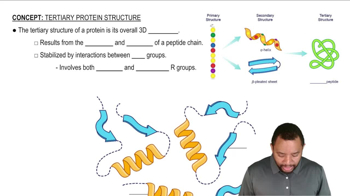
Tertiary Structure of Proteins

The tertiary structure of a protein refers to its overall three-dimensional shape, formed by the folding and interactions of its amino acid side chains. This structure is critical for the protein's function, as it determines how the protein interacts with other molecules. The specific interactions between side chains, such as those between alanine and valine, play a significant role in stabilizing this structure.
Video consigliato:
Percorso guidato
2:07
Tertiary Protein Structure Concept 1