Ch.11 Nucleic Acids Big Molecules with a Big Role
Frost - General, Organic and Biological Chemistry 4th Edition
Frost4th EditionGeneral, Organic and Biological ChemistryISBN: 9780134988696Non è quello che usi tu?Cambia libro di testo
Capitolo 7, Problema 12

Describe the differences in the two ends of a nucleic acid.

Guida verificata passo dopo passo
1
Understand that nucleic acids, such as DNA and RNA, are polymers made up of nucleotide monomers. Each nucleotide consists of three components: a phosphate group, a sugar molecule, and a nitrogenous base.
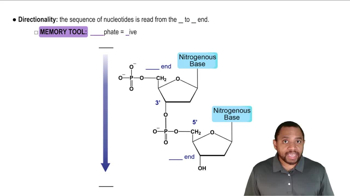
Recognize that nucleic acids have directionality, meaning they have two distinct ends: the 5' (five-prime) end and the 3' (three-prime) end. This directionality is crucial for processes like replication and transcription.
At the 5' end of a nucleic acid, there is typically a phosphate group attached to the fifth carbon of the sugar molecule in the nucleotide. This phosphate group gives the 5' end its distinct chemical identity.
At the 3' end of a nucleic acid, there is a hydroxyl (-OH) group attached to the third carbon of the sugar molecule in the nucleotide. This hydroxyl group is essential for forming bonds with incoming nucleotides during polymerization.
Summarize the difference: The 5' end is characterized by a phosphate group, while the 3' end is characterized by a hydroxyl group. This structural distinction is key to the function and synthesis of nucleic acids.

Risposta video verificata per un problema simile:

Questa soluzione video è stata consigliata dai nostri tutor come utile per risolvere questo problema.
Durata del video:
2m

Concetti chiave

Ecco i concetti essenziali che devi comprendere per rispondere correttamente alla domanda.

Nucleic Acid Structure

Nucleic acids, such as DNA and RNA, are polymers made up of nucleotide monomers. Each nucleotide consists of a sugar, a phosphate group, and a nitrogenous base. The structure of nucleic acids is directional, with a 5' end (phosphate group) and a 3' end (hydroxyl group), which is crucial for understanding their function in biological processes.
Video consigliato:
Percorso guidato
0:56
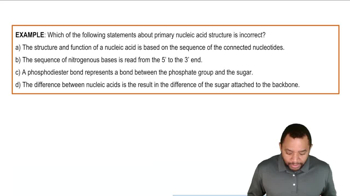
Primary Structure of Nucleic Acids Example 2

5' and 3' Ends

The 5' end of a nucleic acid strand has a free phosphate group attached to the fifth carbon of the sugar, while the 3' end has a free hydroxyl group on the third carbon. This polarity is essential for processes like DNA replication and transcription, as enzymes add nucleotides to the 3' end, elongating the strand in a specific direction.
Video consigliato:
Percorso guidato
1:43
Primary Structure of Nucleic Acids Concept 2

Functionality in Biological Processes

The differences between the 5' and 3' ends of nucleic acids are critical for their functionality in biological processes. For instance, during DNA replication, the leading strand is synthesized continuously in the 5' to 3' direction, while the lagging strand is synthesized in short fragments. Understanding these differences helps clarify how genetic information is accurately copied and expressed.
Video consigliato:
Percorso guidato
2:25
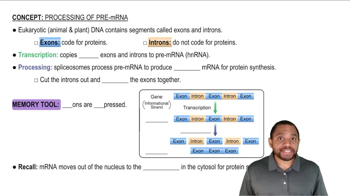
Processing of Pre-mRNA Concept 1