Ch.11 Nucleic Acids Big Molecules with a Big Role
Frost - General, Organic and Biological Chemistry 4th Edition
Frost4th EditionGeneral, Organic and Biological ChemistryISBN: 9780134988696Non è quello che usi tu?Cambia libro di testo
Capitolo 7, Problema 63b

Write the complementary base sequence for each of the following DNA segments. Indicate the 5' and the 3' ends.
b. 5'ATAGCCCTTACTGG3'

Guida verificata passo dopo passo
1
Identify the given DNA sequence: 5'-ATAGCCCTTACTGG-3'.
Recall that DNA is double-stranded and the strands are complementary and antiparallel.
Use the base pairing rules: Adenine (A) pairs with Thymine (T), and Cytosine (C) pairs with Guanine (G).
Write the complementary bases for each nucleotide in the sequence: A pairs with T, T pairs with A, C pairs with G, and G pairs with C.
Reverse the order of the complementary sequence to reflect the antiparallel nature, indicating the 5' and 3' ends.

Risposta video verificata per un problema simile:

Questa soluzione video è stata consigliata dai nostri tutor come utile per risolvere questo problema.
Durata del video:
3m

Concetti chiave

Ecco i concetti essenziali che devi comprendere per rispondere correttamente alla domanda.

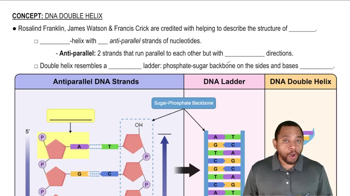
DNA Structure

DNA is composed of two strands that form a double helix, with each strand made up of nucleotides. Each nucleotide consists of a sugar, a phosphate group, and a nitrogenous base. The four types of nitrogenous bases are adenine (A), thymine (T), cytosine (C), and guanine (G). In DNA, A pairs with T and C pairs with G, which is crucial for determining complementary sequences.
Video consigliato:
Percorso guidato
3:27
DNA Double Helix Concept 1

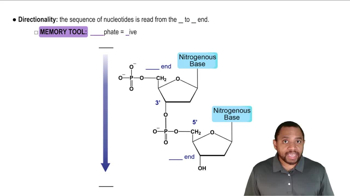
5' and 3' Ends

The terms 5' (five prime) and 3' (three prime) refer to the directionality of the DNA strands. The 5' end has a phosphate group attached to the fifth carbon of the sugar, while the 3' end has a hydroxyl group attached to the third carbon. This orientation is important for DNA replication and transcription, as enzymes that synthesize DNA and RNA can only add nucleotides to the 3' end of a growing strand.
Video consigliato:
Percorso guidato
1:43
Primary Structure of Nucleic Acids Concept 2

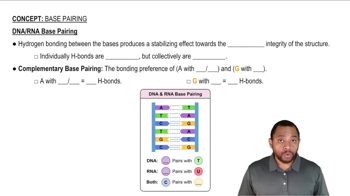
Complementary Base Pairing

Complementary base pairing is the principle that dictates how nitrogenous bases pair in DNA. Adenine pairs with thymine, and cytosine pairs with guanine, forming specific base pairs that stabilize the DNA structure. When determining the complementary sequence of a DNA strand, it is essential to replace each base with its corresponding pair while also considering the correct orientation of the 5' and 3' ends.
Video consigliato:
Percorso guidato
2:56
Base Pairing Concept 1