Ch.12 Food as Fuel An Overview of Metabolism
Frost - General, Organic and Biological Chemistry 4th Edition
Frost4th EditionGeneral, Organic and Biological ChemistryISBN: 9780134988696Non è quello che usi tu?Cambia libro di testo
Capitolo 8, Problema 89

How many ATP are produced when glucose is oxidized to pyruvate compared to when glucose is oxidized to CO2 and H2O?

Guida verificata passo dopo passo
1
Step 1: Understand the two processes involved in glucose metabolism: glycolysis (oxidation of glucose to pyruvate) and cellular respiration (oxidation of glucose to CO₂ and H₂O). Glycolysis occurs in the cytoplasm, while cellular respiration occurs in the mitochondria.
Step 2: Recall that during glycolysis, glucose (C₆H₁₂O₆) is converted into two molecules of pyruvate (C₃H₄O₃). This process generates a net gain of 2 ATP molecules and 2 NADH molecules.
Step 3: For the complete oxidation of glucose to CO₂ and H₂O, the pyruvate produced in glycolysis enters the mitochondria and undergoes the citric acid cycle (Krebs cycle) and oxidative phosphorylation. Each NADH and FADH₂ generated in these processes contributes to ATP production via the electron transport chain.
Step 4: Recall the approximate ATP yield from cellular respiration: each NADH contributes about 2.5 ATP, and each FADH₂ contributes about 1.5 ATP. The complete oxidation of glucose to CO₂ and H₂O yields approximately 30-32 ATP molecules, depending on the efficiency of the electron transport chain.
Step 5: Compare the ATP yield: glycolysis alone produces 2 ATP, while the complete oxidation of glucose to CO₂ and H₂O produces significantly more ATP (30-32 ATP). This highlights the efficiency of cellular respiration in energy production.

Risposta video verificata per un problema simile:

Questa soluzione video è stata consigliata dai nostri tutor come utile per risolvere questo problema.
Durata del video:
10m

Concetti chiave

Ecco i concetti essenziali che devi comprendere per rispondere correttamente alla domanda.

Glycolysis

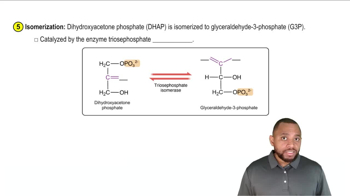
Glycolysis is the metabolic pathway that converts glucose into pyruvate, producing a net gain of 2 ATP molecules per glucose molecule. This process occurs in the cytoplasm and does not require oxygen, making it an anaerobic pathway. Glycolysis is the first step in cellular respiration and is crucial for energy production in both aerobic and anaerobic conditions.
Video consigliato:
Percorso guidato
1:26
Glycolysis Concept 5

Cellular Respiration

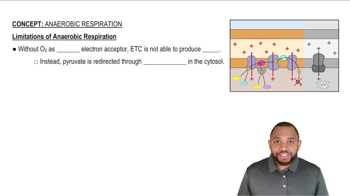
Cellular respiration is the process by which cells convert glucose into usable energy in the form of ATP. It consists of three main stages: glycolysis, the citric acid cycle, and oxidative phosphorylation. When glucose is fully oxidized to carbon dioxide and water, a total of approximately 30-32 ATP molecules can be produced, highlighting the efficiency of aerobic respiration compared to glycolysis alone.
Video consigliato:
Percorso guidato
1:47
Anaerobic Respiration Concept 1

ATP Yield

ATP yield refers to the amount of adenosine triphosphate (ATP) produced during metabolic processes. In the context of glucose oxidation, the yield varies significantly depending on the pathway: glycolysis yields 2 ATP, while complete oxidation through cellular respiration can yield up to 32 ATP. Understanding ATP yield is essential for comparing the energy efficiency of different metabolic pathways.
Video consigliato: