Ch.12 Food as Fuel An Overview of Metabolism
Frost - General, Organic and Biological Chemistry 4th Edition
Frost4th EditionGeneral, Organic and Biological ChemistryISBN: 9780134988696Non è quello che usi tu?Cambia libro di testo
Capitolo 8, Problema 83c

Identify the following as the reduced or oxidized form:
c. QH2

Guida verificata passo dopo passo
1
Understand the concepts of oxidation and reduction: Oxidation involves the loss of electrons, while reduction involves the gain of electrons. Reduced forms typically have more hydrogen atoms or fewer oxygen atoms compared to their oxidized counterparts.
Examine the chemical formula QH₂: The presence of hydrogen atoms (H₂) suggests that this molecule has gained electrons, as hydrogen atoms are often associated with reduction.
Compare QH₂ to its potential oxidized form: The oxidized form of QH₂ would likely have fewer hydrogen atoms or more oxygen atoms, indicating a loss of electrons.
Determine the electron state: Since QH₂ has additional hydrogen atoms, it is likely in its reduced form, as the addition of hydrogen is a hallmark of reduction.
Conclude the identification: Based on the analysis, QH₂ is the reduced form of the molecule.

Risposta video verificata per un problema simile:

Questa soluzione video è stata consigliata dai nostri tutor come utile per risolvere questo problema.
Durata del video:
2m

Concetti chiave

Ecco i concetti essenziali che devi comprendere per rispondere correttamente alla domanda.

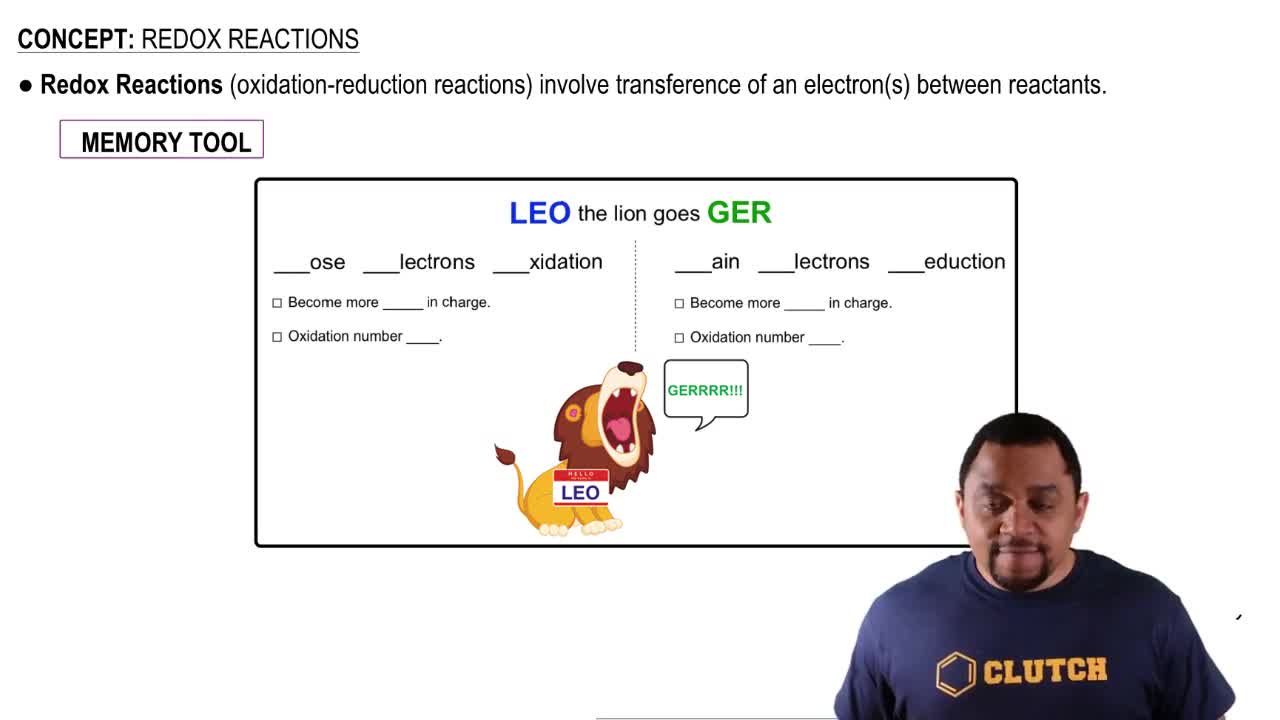
Redox Reactions

Redox reactions involve the transfer of electrons between two species, leading to changes in their oxidation states. In these reactions, one species is oxidized (loses electrons) while another is reduced (gains electrons). Understanding redox processes is crucial for identifying whether a compound is in its reduced or oxidized form.
Video consigliato:
Percorso guidato
01:53
Redox Reactions

Oxidation States

Oxidation states are a way to keep track of electrons in chemical compounds. They indicate the degree of oxidation of an atom in a molecule, with higher oxidation states representing a loss of electrons. For example, in the case of QH₂, the oxidation state of Q is lower than in its oxidized form, which helps determine its reduced status.
Video consigliato:
Percorso guidato
01:01
States of Matter Example 1

Coenzyme Q (Ubiquinone) and Its Forms

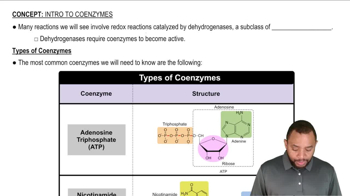
Coenzyme Q, also known as ubiquinone, exists in two forms: oxidized (ubiquinone) and reduced (ubiquinol, QH₂). The reduced form, QH₂, is produced during cellular respiration and plays a vital role in the electron transport chain. Recognizing these forms is essential for understanding their function in metabolic processes.
Video consigliato:
Percorso guidato
2:23
Intro to Coenzymes Concept 1