Ch.12 Food as Fuel An Overview of Metabolism
Frost - General, Organic and Biological Chemistry 4th Edition
Frost4th EditionGeneral, Organic and Biological ChemistryISBN: 9780134988696Non è quello che usi tu?Cambia libro di testo
Capitolo 8, Problema 9a

Identify the metabolic nucleotide described by the following:
a. contains the vitamin riboflavin

Guida verificata passo dopo passo
1
Step 1: Understand the problem. The question asks us to identify a metabolic nucleotide that contains the vitamin riboflavin. Riboflavin is also known as vitamin B2, which is a key component of certain coenzymes involved in metabolic processes.
Step 2: Recall the role of riboflavin in metabolism. Riboflavin is a precursor for the synthesis of two important coenzymes: flavin mononucleotide (FMN) and flavin adenine dinucleotide (FAD). These coenzymes are involved in redox reactions in cellular metabolism.
Step 3: Focus on the term 'nucleotide.' A nucleotide is a molecule composed of a nitrogenous base, a sugar (ribose or deoxyribose), and one or more phosphate groups. FMN and FAD both qualify as nucleotides because they contain these components.
Step 4: Analyze the structure of FMN and FAD. FMN (flavin mononucleotide) contains riboflavin attached to a phosphate group, while FAD (flavin adenine dinucleotide) contains riboflavin linked to an adenine nucleotide via a phosphate bridge.
Step 5: Conclude that the metabolic nucleotide described in the problem is either FMN or FAD, as both contain riboflavin and play critical roles in metabolism.

Risposta video verificata per un problema simile:

Questa soluzione video è stata consigliata dai nostri tutor come utile per risolvere questo problema.
Durata del video:
2m

Concetti chiave

Ecco i concetti essenziali che devi comprendere per rispondere correttamente alla domanda.

Metabolic Nucleotides

Metabolic nucleotides are organic molecules that serve as the building blocks of nucleic acids (DNA and RNA) and play critical roles in cellular metabolism. They consist of a nitrogenous base, a sugar, and one or more phosphate groups. Understanding their structure and function is essential for grasping how they contribute to energy transfer and signaling within cells.
Video consigliato:
Percorso guidato
1:21
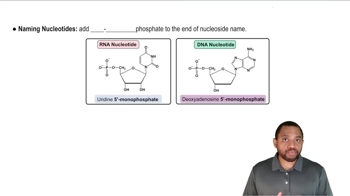
Naming Nucleosides and Nucleotides Concept 2

Riboflavin

Riboflavin, also known as vitamin B2, is a water-soluble vitamin that is crucial for energy production and the metabolism of fats, drugs, and steroids. It serves as a precursor for the coenzymes flavin mononucleotide (FMN) and flavin adenine dinucleotide (FAD), which are vital for various enzymatic reactions in the body. Its presence in metabolic nucleotides indicates a link between vitamins and nucleotide metabolism.

Nucleotide Structure

Nucleotides are composed of three main components: a nitrogenous base (adenine, guanine, cytosine, or thymine/uracil), a five-carbon sugar (ribose or deoxyribose), and one or more phosphate groups. The specific arrangement of these components determines the nucleotide's function and its role in cellular processes, including energy transfer (as in ATP) and the synthesis of nucleic acids.
Video consigliato:
Percorso guidato
1:19
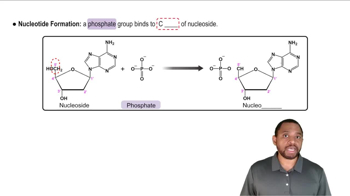
Nucleoside and Nucleotide Formation Concept 2