Ch.12 Food as Fuel An Overview of Metabolism
Frost - General, Organic and Biological Chemistry 4th Edition
Frost4th EditionGeneral, Organic and Biological ChemistryISBN: 9780134988696Non è quello che usi tu?Cambia libro di testo
Capitolo 8, Problema 74

Which of the reactions given in Problems 12.72 represent isomerizations where the reactants and products are structural isomers?
a. glucose to glucose-6-phosphate
b. glyceraldehyde-3-phosphate to 1,3-bisphosphoglycerate
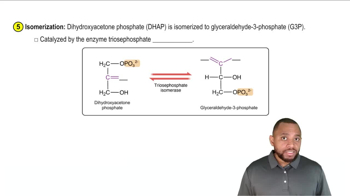
c. dihydroxyacetone phosphate to glyceraldehyde-3-phosphate

Guida verificata passo dopo passo
1
Understand the concept of isomerization: Isomerization is a chemical reaction where a molecule is transformed into another molecule with the same molecular formula but a different structural arrangement. Structural isomers differ in the connectivity of atoms within the molecule.
Review the reactions provided in Problems 12.72. For each reaction, compare the molecular formula of the reactants and products to ensure they are identical. This confirms that the reactants and products are isomers.
Examine the structural arrangement of the reactants and products. Check if the connectivity of atoms changes between the reactants and products, which is a key characteristic of structural isomers.
Identify any reactions where the molecular formula remains the same and the connectivity of atoms changes. These reactions represent isomerizations involving structural isomers.
List the reactions that meet the criteria for isomerization. Ensure that you clearly distinguish these from other types of reactions, such as rearrangements that do not involve structural isomers.

Risposta video verificata per un problema simile:

Questa soluzione video è stata consigliata dai nostri tutor come utile per risolvere questo problema.
Durata del video:
4m

Concetti chiave

Ecco i concetti essenziali che devi comprendere per rispondere correttamente alla domanda.

Isomerization

Isomerization is a chemical reaction in which a molecule is transformed into another molecule that has the same atoms but a different arrangement. This process can lead to structural isomers, which differ in the connectivity of their atoms, or stereoisomers, which differ in the spatial arrangement of atoms. Understanding isomerization is crucial for identifying reactions that produce structural isomers.
Video consigliato:
Percorso guidato
1:26
Glycolysis Concept 5

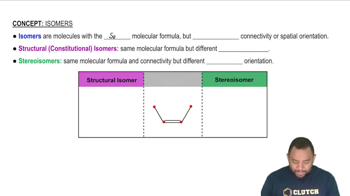
Structural Isomers

Structural isomers are compounds that share the same molecular formula but have different structural formulas, meaning the connectivity of atoms varies. This can result in different physical and chemical properties. Recognizing structural isomers is essential for analyzing reactions, as it helps determine whether a reaction leads to a new compound with distinct characteristics.
Video consigliato:
Percorso guidato
2:16
Isomers Concept 1

Reaction Mechanism

A reaction mechanism is a detailed description of the steps involved in a chemical reaction, including the formation and breaking of bonds. Understanding the mechanism allows chemists to predict the products of a reaction and identify whether isomerization occurs. Analyzing the mechanism is key to determining if the reactants and products are structural isomers.
Video consigliato:
Percorso guidato
1:30
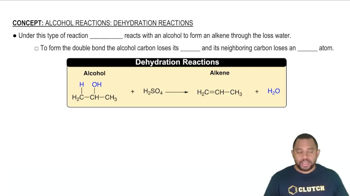
Alcohol Reactions: Dehydration Reactions Concept 1