Ch.4 Introduction to Organic Compounds
Frost - General, Organic and Biological Chemistry 4th Edition
Frost4th EditionGeneral, Organic and Biological ChemistryISBN: 9780134988696Non è quello che usi tu?Cambia libro di testo
Capitolo 1, Problema 79a

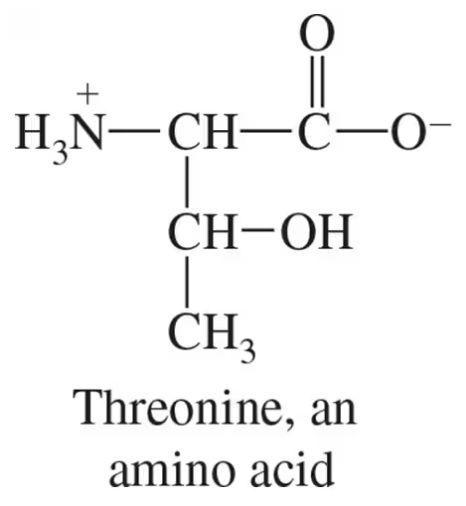
Mark the chiral centers in the following molecules, if any, with an asterisk (*).
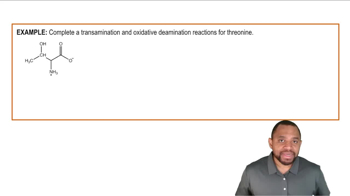
(a) Chemical structure of threonine, an amino acid, with chiral centers marked by asterisks.

Guida verificata passo dopo passo
1
Step 1: Understand the concept of a chiral center. A chiral center is a carbon atom that is bonded to four different groups or atoms. This asymmetry makes the molecule non-superimposable on its mirror image.
Step 2: Examine the structure of threonine (an amino acid). Identify all the carbon atoms in the molecule and analyze the groups attached to each carbon atom.
Step 3: For each carbon atom, check if it is bonded to four distinct groups. If a carbon atom meets this criterion, it is a chiral center and should be marked with an asterisk (*).
Step 4: Pay special attention to the alpha carbon (the carbon atom bonded to the amino group, carboxyl group, hydrogen, and the side chain) in threonine, as it is often a chiral center in amino acids. Additionally, examine the side chain of threonine for any other potential chiral centers.
Step 5: Once all chiral centers are identified, mark them with an asterisk (*) on the molecular structure. Ensure that you have carefully checked all carbon atoms to avoid missing any chiral centers.

Risposta video verificata per un problema simile:

Questa soluzione video è stata consigliata dai nostri tutor come utile per risolvere questo problema.
Durata del video:
2m

Concetti chiave

Ecco i concetti essenziali che devi comprendere per rispondere correttamente alla domanda.

Chirality

Chirality refers to the geometric property of a molecule that makes it non-superimposable on its mirror image. A chiral molecule typically has at least one carbon atom bonded to four different substituents, creating two distinct forms known as enantiomers. This property is crucial in biochemistry, as many biological molecules, including amino acids, exhibit chirality, influencing their interactions and functions.
Video consigliato:
Percorso guidato
1:39
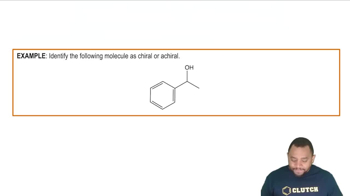
Chirality Example 1

Chiral Centers

A chiral center, often a carbon atom, is a specific atom in a molecule that is bonded to four different groups or atoms. The presence of chiral centers in a molecule is what gives rise to its chirality. Identifying these centers is essential for understanding the molecule's stereochemistry and how it may interact with other chiral substances, such as enzymes or receptors in biological systems.
Video consigliato:
Percorso guidato
2:37
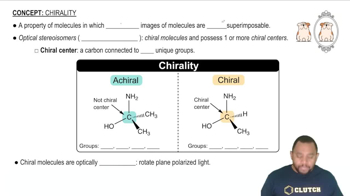
Chirality Concept 1

Threonine

Threonine is an essential amino acid that plays a vital role in protein synthesis and various metabolic processes. It contains a chiral center, making it a chiral molecule. Understanding the structure of threonine, including its chiral center, is important for studying its function in proteins and its interactions in biological systems, as the specific orientation of its atoms can affect its biological activity.
Video consigliato:
Percorso guidato
3:03
Amino Acid Catabolism: Amino Group Example 2