Ch.4 Introduction to Organic Compounds
Frost - General, Organic and Biological Chemistry 4th Edition
Frost4th EditionGeneral, Organic and Biological ChemistryISBN: 9780134988696Non è quello che usi tu?Cambia libro di testo
Capitolo 1, Problema 35a

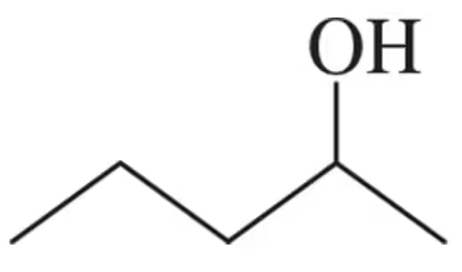
Mark the chiral centers in the following molecules, if any, with an asterisk (*):
(a) Structural formula of a molecule with an -OH group, indicating potential chiral centers to be marked with an asterisk.

Guida verificata passo dopo passo
1
Identify the definition of a chiral center: A chiral center is a carbon atom that is bonded to four different groups or atoms. This asymmetry makes the carbon atom chiral.
Examine the structure of the molecule provided in the image. Focus on each carbon atom individually to determine if it is bonded to four distinct groups or atoms.
For each carbon atom, check the groups or atoms attached to it. If all four groups are different, mark that carbon as a chiral center with an asterisk (*).
If a carbon atom is bonded to two or more identical groups, it cannot be a chiral center. Skip marking such carbons.
Repeat this process for all carbon atoms in the molecule to ensure no chiral centers are missed. Mark all identified chiral centers with an asterisk (*).

Risposta video verificata per un problema simile:

Questa soluzione video è stata consigliata dai nostri tutor come utile per risolvere questo problema.
Durata del video:
3m

Concetti chiave

Ecco i concetti essenziali che devi comprendere per rispondere correttamente alla domanda.

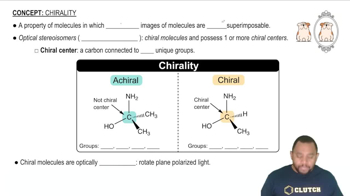
Chirality

Chirality refers to the geometric property of a molecule that makes it non-superimposable on its mirror image. A chiral molecule typically has at least one carbon atom bonded to four different substituents, creating two distinct forms known as enantiomers. Understanding chirality is essential for identifying chiral centers in organic compounds.
Video consigliato:
Percorso guidato
1:39
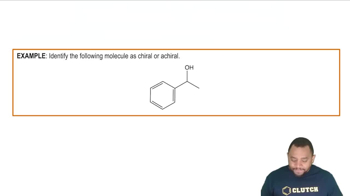
Chirality Example 1

Chiral Centers

A chiral center, often a carbon atom, is a point in a molecule where the interchange of two groups leads to a different configuration. Identifying chiral centers is crucial for determining the optical activity of a compound, as these centers are responsible for the molecule's ability to rotate plane-polarized light. In the context of the question, marking these centers is necessary for proper stereochemical representation.
Video consigliato:
Percorso guidato
2:37
Chirality Concept 1

Stereochemistry

Stereochemistry is the study of the spatial arrangement of atoms in molecules and how this arrangement affects their chemical properties and reactions. It encompasses concepts like chirality and enantiomers, which are vital for understanding how different molecular configurations can lead to different biological activities. In the given question, a solid grasp of stereochemistry is needed to accurately identify and mark chiral centers.
Video consigliato:
Percorso guidato
1:30
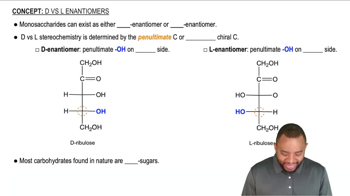
D vs L Enantiomers Concept 1