Ch.4 Introduction to Organic Compounds
Frost - General, Organic and Biological Chemistry 4th Edition
Frost4th EditionGeneral, Organic and Biological ChemistryISBN: 9780134988696Non è quello che usi tu?Cambia libro di testo
Capitolo 1, Problema 21

The most prevalent fatty acid in coconut oil is lauric acid, a saturated fatty acid containing 12 carbons. Draw lauric acid in skeletal structure.

Guida verificata passo dopo passo
1
Understand the structure of lauric acid: Lauric acid is a saturated fatty acid, meaning it contains no double bonds in its carbon chain. It has 12 carbon atoms in total, with a carboxylic acid functional group (-COOH) at one end.
Start by drawing the carboxylic acid group (-COOH) at the leftmost end of the skeletal structure. This group is represented as a carbon atom double-bonded to an oxygen atom and single-bonded to a hydroxyl group (-OH).
Next, draw a straight chain of 11 additional carbon atoms extending from the carboxylic acid group. Since lauric acid is saturated, there are no double or triple bonds between these carbon atoms.
For the skeletal structure, represent each carbon atom in the chain as a vertex (a bend or end of a line) without explicitly showing the hydrogen atoms. Each carbon atom in the chain will have enough hydrogens to satisfy the octet rule (4 bonds total).
Ensure the structure is complete by verifying that the chain has 12 carbons in total, including the carbon in the carboxylic acid group, and that all bonds are single bonds, as lauric acid is fully saturated.

Risposta video verificata per un problema simile:

Questa soluzione video è stata consigliata dai nostri tutor come utile per risolvere questo problema.
Durata del video:
1m

Concetti chiave

Ecco i concetti essenziali che devi comprendere per rispondere correttamente alla domanda.

Skeletal Structure of Organic Molecules

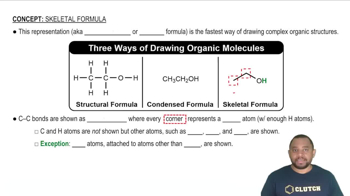
The skeletal structure, or line-angle structure, is a simplified way of representing organic molecules. In this format, carbon atoms are represented by the ends and intersections of lines, while hydrogen atoms are typically omitted for clarity. This method allows chemists to easily visualize the molecular framework and functional groups without cluttering the diagram with hydrogen atoms.
Video consigliato:
Percorso guidato
2:26
Skeletal Formula Concept 1

Saturated Fatty Acids

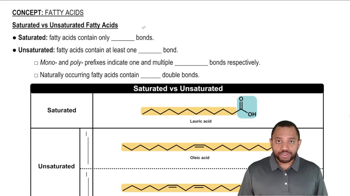
Saturated fatty acids are types of fatty acids that have no double bonds between carbon atoms, meaning they are fully 'saturated' with hydrogen atoms. This structure results in a straight chain, allowing them to pack closely together, which contributes to their solid state at room temperature. Lauric acid, with its 12 carbon atoms, is a typical example of a saturated fatty acid found in coconut oil.
Video consigliato:
Percorso guidato
2:26
Fatty Acids Concept 2

Chemical Structure of Lauric Acid

Lauric acid is a medium-chain saturated fatty acid with the chemical formula C12H24O2. Its structure consists of a long hydrocarbon chain with a carboxylic acid group (-COOH) at one end. Understanding its structure is essential for recognizing its properties and potential health benefits, as well as its role in various biological processes.
Video consigliato:
Percorso guidato
00:58
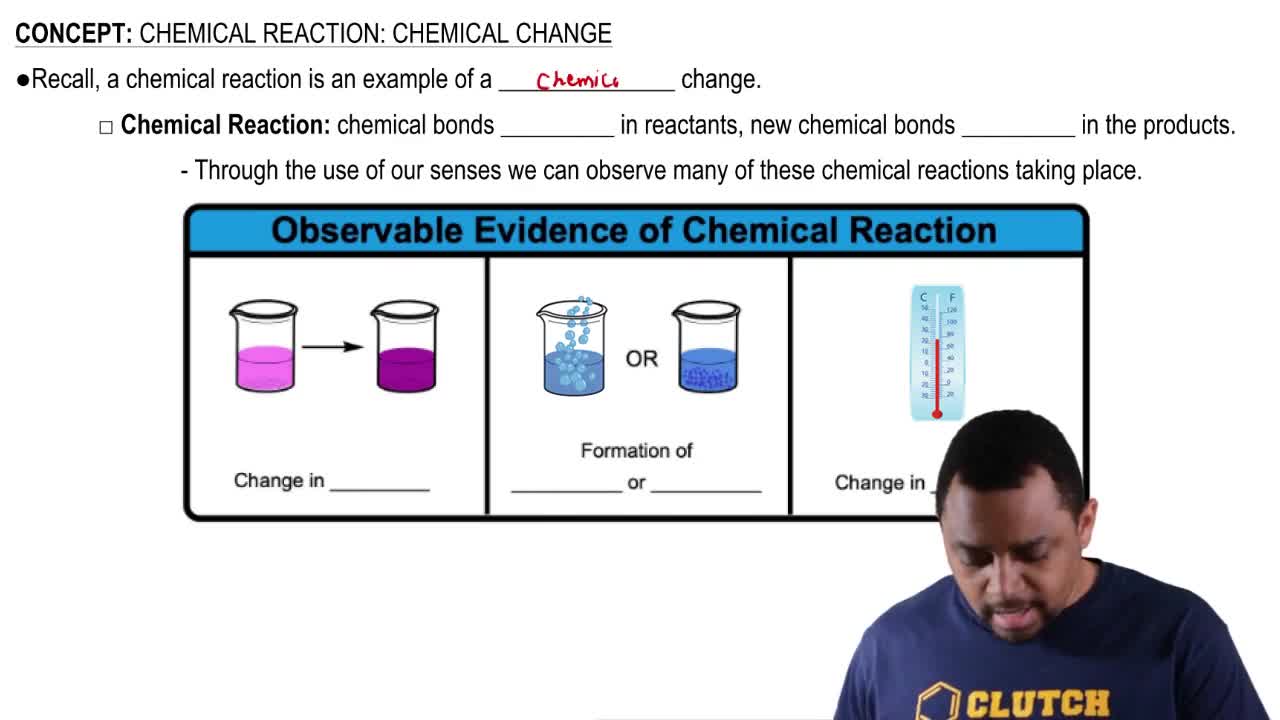
Chemical Reaction: Chemical Change Concept 1